
News
Area Scan vs. Line Scan Cameras: Which One Fits Your Production Line?
Short answer: An area scan camera captures a full two-dimensional image in a single exposure, making it the right choice for stationary or step-and-repeat inspection. A line scan camera captures one row of pixels at a time and builds the complete image as the object moves continuously past the sensor, which makes it better suited to continuous webs, round objects, and very large or fast-moving parts. In short: area scan cameras photograph a scene; line scan cameras scan a moving surface.
What Is an Area Scan Camera?
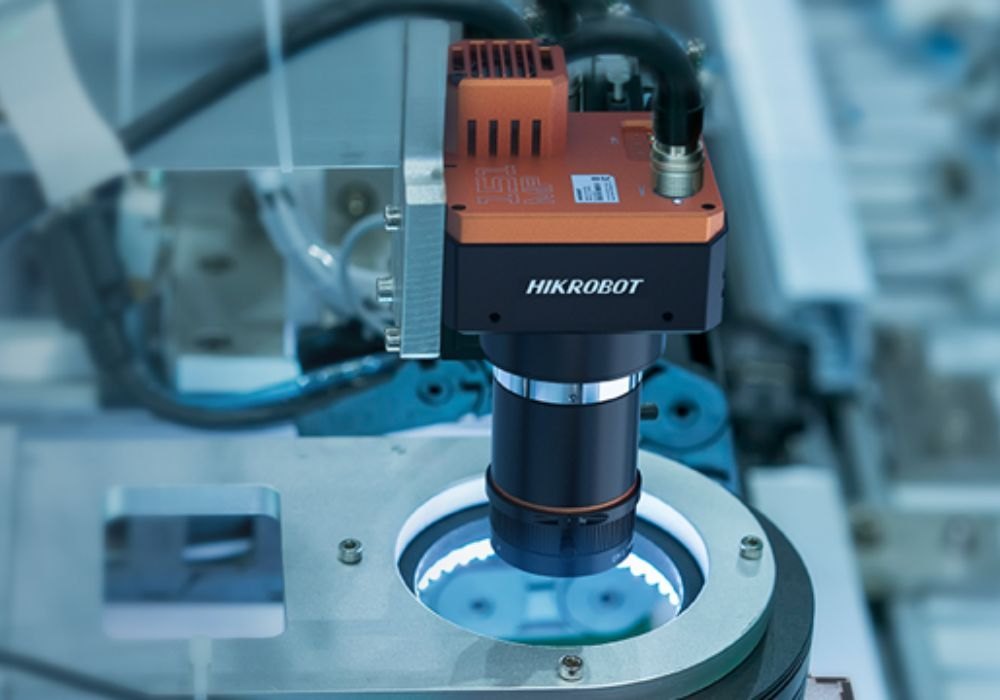
An area scan camera is an industrial camera that captures a complete two-dimensional image — width and height — in one exposure, the same way a standard digital camera does. The sensor is a grid of pixels, so a single trigger produces a full frame ready for analysis.
This makes area scan the default choice for most machine vision tasks: checking a part's presence, reading a 2D code, measuring a feature, or verifying an assembly, all from one still image. Hikrobot's area scan camera lineup spans several sensor formats — the CE, CA, CH, CB, CU, and CS series cover a resolution range from 0.3 to 604 megapixels, so the right choice depends on how much detail the inspection actually needs. A camera like the CB Series, for example, is built for general-purpose inspection where one full frame per trigger is enough.
What Is a Line Scan Camera?
A line scan camera captures image data one row of pixels at a time. Instead of taking a full picture, the sensor continuously reads a single line, and the complete image is assembled as the object — or the camera — moves past it, typically synchronized to an encoder that tracks the object's motion.
This design is what makes line scan cameras suited to continuous or moving material: a web of film, paper, or textile passing on a roller, a cylindrical part rotating in front of the lens, or a part too long to fit inside a single area scan frame. Hikrobot's CL Series covers a pixel range from 2K to 16K per line, so the right model depends on how much fine detail the scanned line needs to resolve.
What's the Difference Between Area Scan and Line Scan Cameras?
The practical difference comes down to how the image is built. An area scan camera needs the object to be still, or at least momentarily paused, for a clean frame. A line scan camera needs the opposite: continuous, precisely tracked motion, because the image only exists once enough lines have been scanned and stitched together. The table below summarizes where each option holds the advantage.
Area Scan vs. Line Scan: Key Differences at a Glance
| Factor | Area Scan Camera | Line Scan Camera |
|---|---|---|
| Image capture | Full 2D frame in one exposure | One pixel row at a time, assembled in motion |
| Object motion | Best with stationary or indexed parts | Requires continuous, encoder-tracked motion |
| Typical use | Discrete parts, assemblies, 2D codes | Webs, rolls, round or oversized objects |
| Field of view | Fixed frame size | Effectively unlimited along the scan direction |
| Lighting | Flexible — ring, bar, or dome lights | Uniform line lighting matched to the scan line |
Neither type is universally "better" — they solve different imaging problems. A production line built around discrete, boxed parts rarely needs a line scan camera, and a continuous web line can't be inspected properly with an area scan camera alone, however high its resolution.
When Should You Use an Area Scan Camera?
Area scan cameras fit any application where the part is stationary, indexed, or briefly paused for inspection: presence/absence checks, dimensional measurement, surface defect detection, and reading 1D or 2D codes on discrete items. Because the sensor captures the entire field of view at once, area scan is also the simpler starting point for general assembly and quality-control tasks on step-and-repeat lines.
For straightforward inspection tasks, an all-in-one smart camera — which combines the sensor and processing in a single unit — can be a simpler alternative to a standalone area scan camera paired with a separate controller, particularly on lines with just one or two inspection points.
When Should You Use a Line Scan Camera?
Line scan cameras are the better fit whenever the material moves continuously or doesn't fit inside a single frame. Typical cases include web inspection for paper, film, and textiles; surface and print quality control on rolls; and full-circumference inspection of cylindrical parts as they rotate past the sensor. They're also common on high-speed sorting and grading lines, where a continuous scan keeps up with product flow better than repeatedly triggering and resetting an area scan camera.
Because the image builds line by line, accuracy depends on how precisely the object's speed is tracked — inconsistent motion distorts the final image, which is why line scan systems are typically paired with an encoder rather than a fixed frame rate.
Do Area Scan and Line Scan Cameras Need Different Lenses and Lighting?
Yes. Area scan setups have more flexibility in lens and lighting choice, since the entire scene is lit and imaged at once — ring, bar, or dome lighting can all work depending on the part. For precision measurement tasks, a telecentric lens is often used with an area scan camera to keep magnification constant regardless of small changes in working distance.
Line scan systems are more particular: they need uniform, high-intensity lighting concentrated along the exact line being scanned, which is why line lighting is built specifically for this purpose rather than adapted from general-purpose area lighting.
What Else Do You Need Besides the Camera?
Both camera types are only one part of a working industrial vision camera system. Image data still needs a vision controller to process frames and turn them into pass/fail or measurement decisions, along with cables and connectivity hardware such as frame grabbers — available among Hikrobot's vision components — for high-bandwidth line scan setups. None of this changes which camera type is right for the job; it simply means camera selection is the first step in a larger system, not the only one.
Area Scan or Line Scan: Which One Fits Your Production Line?
Machine vision camera selection for this comparison comes down to one question: does your material move continuously, or can it be paused for inspection? If your parts are discrete and can be briefly stopped or indexed, an area scan camera is almost always the right starting point. If your material moves continuously — a web, a roll, a rotating part, or anything too large for one frame — a line scan camera is built for exactly that. Some production lines genuinely need both: area scan for individual component checks and line scan for continuous web or surface inspection further down the same line.
As an official Hikrobot distributor, Elvotec can help match the right camera, lens, and lighting combination to your specific production line — building on the fundamentals covered in our machine vision guide.
Frequently Asked Questions
Can a line scan camera inspect a stationary object?
Not effectively. A line scan camera depends on continuous, tracked motion to build a complete image; without it, the sensor only captures a single line rather than a usable frame.
Is a line scan camera faster than an area scan camera?
For continuous material, yes — a line scan camera can keep scanning indefinitely without resetting between frames, which suits high-speed, non-stop production better than repeatedly triggering an area scan camera.
Do line scan cameras need a special conveyor or encoder?
Not a special conveyor, but they do need a way to track the object's speed precisely, which is typically an encoder. Inconsistent motion without proper tracking will distort the assembled image.
Which camera type is better for reading barcodes?
For codes on discrete, stationary parts, an area scan camera is the standard choice. For codes printed on a continuously moving web or roll, a line scan camera fits the process better.
Can area scan and line scan cameras work on the same production line?
Yes. Many lines use area scan cameras for discrete part or assembly checks and line scan cameras for continuous web, surface, or roll inspection elsewhere on the same line.