
Consumer products
Consumer Goods Automation Solutions
Short answer: Consumer goods automation uses machine vision and cobots to check, verify, pack and stack everyday products with less manual work. Hikrobot cameras inspect shape, print, color, codes and fill level on the line. JAKA cobots handle packing, palletizing, loading and unloading, sorting and screw driving.
Why Does Consumer Goods Automation Matter?
Consumer products come in many models, and each model needs the right print, color, shape and code. Several of the Hikrobot cases below start from the same requirement: inspect different models on one line. Hikrobot lists the answer as an advantage: multiple solutions can be saved, one for each model.
Manual work is the other side of the problem. JAKA’s home appliances page names two pain points: manual operations make yield and quality unstable, and diverse production needs can require new specialized equipment. Cameras take over the checking, and cobots take over the repeated handling.
What Is Consumer Goods Automation?
Consumer goods automation means using cameras, robots and cobots to inspect and move products in factories that make everyday items. Consumer packaged goods automation (CPG automation) covers the same work for packaged products, such as soap and bottled goods.
End-to-end automation for consumer goods links both ends of the line. Vision checks the product, its print and its code. Cobots then pack, stack and load it. New to the technology? Start with what machine vision is.
Which Brands Can You Use for Consumer Goods Automation Solutions?
ELVOTEC integrates several brands that cover automation solutions for consumer goods manufacturing:
- Hikrobot: machine vision for measurement, print and color checks, and OCR.
- JAKA: collaborative robots for packing, palletizing, sorting and screw driving.
- DH-Robotics: electric grippers for the robot end.
- SDKELI and Akusense: safety lidar and light curtains for guarding the cell.
The table shows which technology fits each job.
|
Job |
Typical technology |
|---|---|
| Measure products and check markings | Hikrobot smart cameras |
| Read and verify printed codes | Hikrobot area scan camera with Vision Master software |
| Check color and fill level | Hikrobot smart cameras |
| Pack, stack and load | JAKA cobots, with DH-Robotics grippers |
| Sort and drive screws | JAKA compact and Zu cobots |
Machine Vision Applications in the Consumer Products Industry
Machine vision for consumer products means cameras and software that check the product, its print and its code on the line, then return a pass or fail result. The seven cases below follow Hikrobot’s smart product application cases. These vision solutions for consumer goods rely on smart cameras and area scan cameras. For the quality side of vision, see how machine vision improves quality control.
How Does Machine Vision Check Soap Dimensions and Markings?
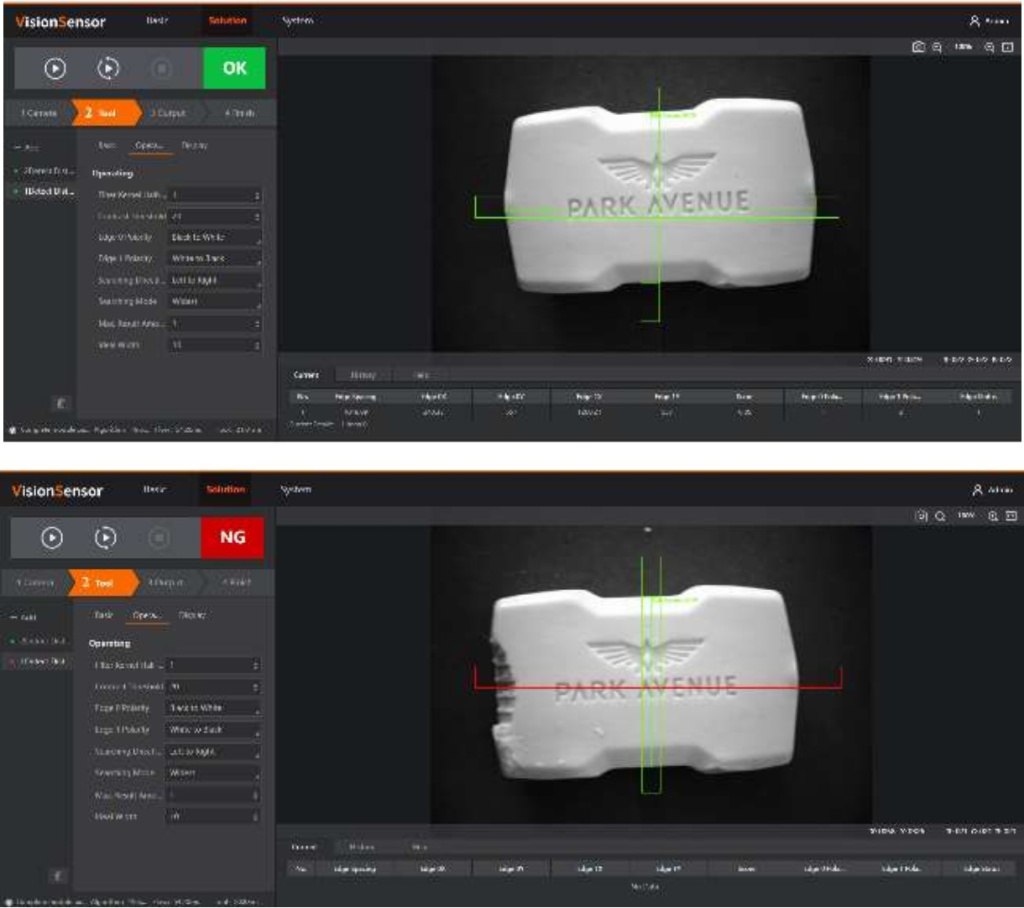
Task: A smart camera measures the outer dimensions of a soap bar and checks that the marking is present.
Requirements:
- Measure the outer dimensions of the soap.
- Check that the marking is present or absent.
- Inspect several soap models.
In Hikrobot’s example, the camera returns OK for an intact bar and NG for a bar with a damaged edge.
Solution:
- MV-SC2016PM: smart camera, with the Match and Measurement tools.
How Does Machine Vision Inspect Printed Packaging?

Task: The camera inspects the print on the soap cover and confirms that the marking is where it should be.
Requirements:
- Inspect the print on the cover.
- Check that the marking is present or absent.
- Inspect different models.
- Verify print alignment.
Hikrobot lists these advantages: the camera, lens and other equipment can be replaced flexibly, solutions are saved for each model, and several protocols connect the camera to a PLC or a third-party system.
Solution:
- MV-SC2016PM: smart camera.
Print checks depend on stable light, so see how to choose a machine vision lens and lighting.
How Does Machine Vision Verify Dot-Print Codes Against PLC Data?

Task: OCR stands for optical character recognition. Here, the camera reads a dot-printed string on the pack and compares it with the string the PLC sends.
Requirements:
- Read dot-printed characters.
- Verify the result against the string shared by the PLC.
- Detect variation in how the characters are printed.
Solution:
- MV-CA050-10GM: area scan camera.
- Vision Master: software. Hikrobot used its OCR tool without deep learning training, plus image filters, an edge tool for the fixture, position correction and communication tools.
For code reading beyond OCR, read the guide to machine vision code reading for traceability.
How Does Machine Vision Check Container Color on a Moving Conveyor?
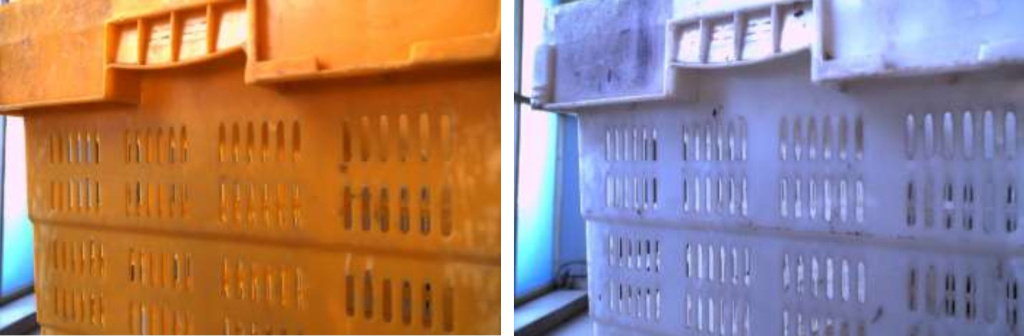
Task: A color smart camera checks the color of material bins as they travel on a conveyor, so the wrong bin does not reach the next station.
Requirements:
- Inspect the color of the bin.
- Work on a moving conveyor, with about 150 mm between bins.
- Save a separate solution for each bin model.
Solution:
- MV-SC2016PC: smart camera for color.
- Software tools: Match, Fixture, Color Extraction, Color Measurement and Blob.
Color results change with light, so choose the right light sources for the station.
How Does Machine Vision Inspect and Measure a Helmet in 360°?
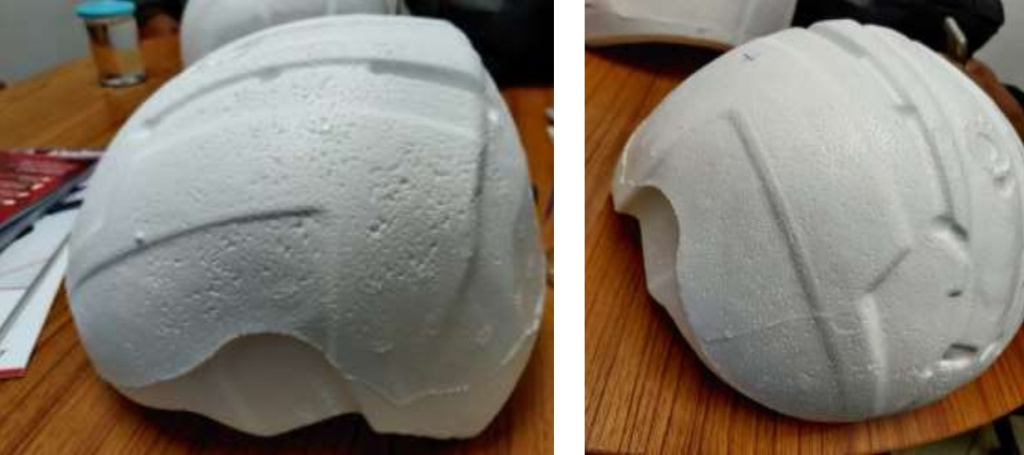
Task: The camera inspects the surface of a helmet and measures the distance along its curve.
Requirements:
- Inspect the surface.
- Measure the helmet curve distance.
- Cover the helmet through 360 degrees.
- Keep up with a cycle time of 60 parts per minute.
- Deliver high accuracy.
Solution:
- MV-CA050-10GM: area scan camera.
- Vision Master: software.
When one station needs several cameras for full coverage, a vision controller can process them together.
How Does Machine Vision Inspect Scratch Labels at 300 Parts per Minute?
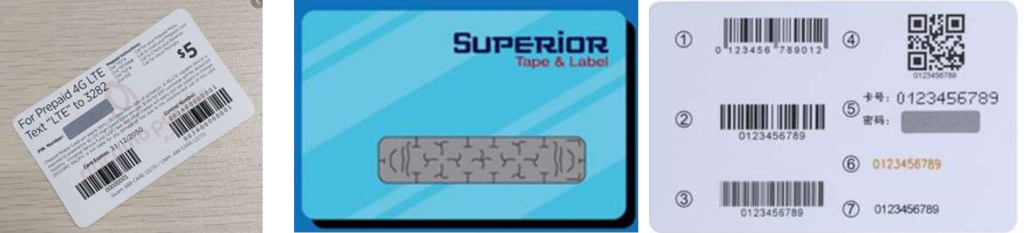
Task: The camera inspects the scratch label and the surface of a card, and verifies the label position, at very high speed.
Requirements:
- Inspect the scratch label.
- Inspect the surface for scratches.
- Verify the label position.
- Handle 300 parts per minute.
Solution:
- MV-SC2016PM: smart camera, with the Match, Blob and Measurement tools.
Hikrobot’s smart camera saves multiple solutions for different models. A smart camera runs the checks on board, which keeps the station compact.
How Does Machine Vision Check Liquid Level in Bottles?
Task: The camera checks whether the liquid in a bottle meets the standard. Hikrobot’s example is a medicine bottle on a conveyor, a task also covered in our pharmaceutical cases.
Requirements:
- Run a line inspection.
- Check that the liquid level meets the standard.
Solution:
- MV-SC2016PM: smart camera with the Line Inspection tool.
Hikrobot lists an embedded platform for high-speed processing and several I/O interfaces. Supported protocols include TCP, UDP, Serial, IO, Modbus, PROFINET, Ethernet/IP and FTP. It also lists accurate level matching and timely data output.
Which Hikrobot Camera Fits Which Consumer Goods Task?
|
Task |
Camera |
Software tools |
|---|---|---|
| Soap dimensions and markings | MV-SC2016PM | Match, Measurement |
| Soap cover print | MV-SC2016PM | Not listed |
| Dot-print OCR | MV-CA050-10GM | Vision Master: OCR, image filters, edge, position correction |
| Bin color | MV-SC2016PC | Match, Fixture, Color Extraction, Color Measurement, Blob |
| Helmet surface and curve | MV-CA050-10GM | Vision Master |
| Scratch label and card surface | MV-SC2016PM | Match, Blob, Measurement |
| Liquid level | MV-SC2016PM | Line Inspection |
JAKA Cobots for Consumer Goods Industry
A cobot is a collaborative robot designed to work beside people. If the term is new, read what a collaborative robot is.
JAKA’s food and beverage industry page lists loading and unloading, packing and palletizing. Its home appliances page adds sorting and screw driving. The models below come from the typical applications on each JAKA product page. The final choice depends on payload, reach and tooling, and this comparison of JAKA cobot series can help.
Can a Cobot Pack Consumer Goods into Cartons?
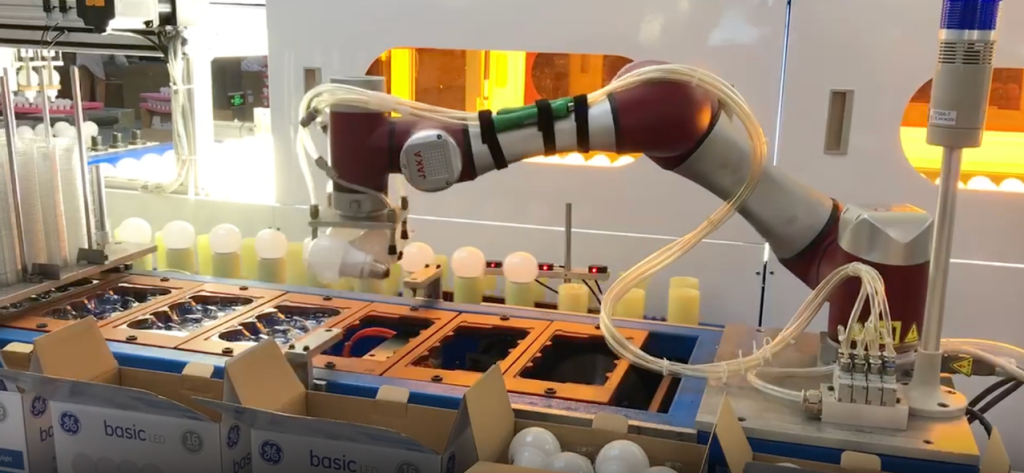
Task: Packing means placing products into boxes and cases. The cobot takes over this repeated step beside the line.
Requirements:
- Repeat each move precisely, to protect product quality and reduce scrap.
- Replace manual labor and lower management costs.
- Raise the production rate.
Solution: JAKA Zu7 (7 kg payload, 819 mm reach), JAKA Zu12 (12 kg, 1,327 mm), JAKA Zu18 (18 kg, 1,073 mm), JAKA Zu20 (20 kg, 1,780 mm) and JAKA Zu30 (30 kg, 1,350 mm). Pair them with DH-Robotics electric grippers chosen for the product.
Can a Cobot Palletize Finished Cartons?
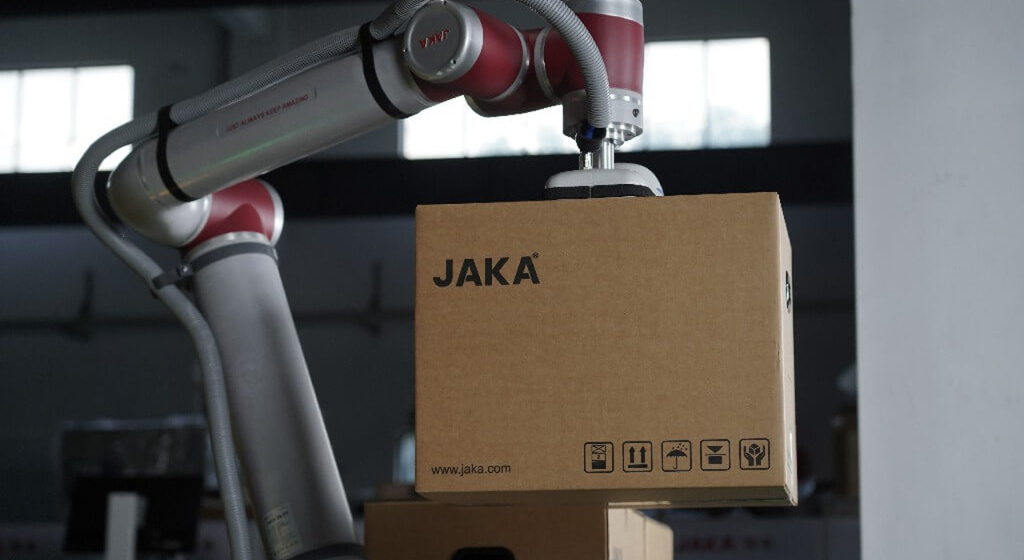
Task: Palletizing means stacking cartons or cases on a pallet for shipping. The cobot does this at the end of the line, so staff no longer lift each case.
Requirements:
- Automate palletizing, raise efficiency and improve the operators’ working environment.
- Fit a compact, lightweight robot into a small footprint.
- Let one robot serve several production lines.
Solution: JAKA Zu12, JAKA Zu20 and JAKA Zu30. Browse the full JAKA Zu series. Guard the cell with SDKELI safety lidar where the risk assessment calls for it. For what happens after the pallet leaves the cell, see the logistics cases.
Can a Cobot Handle Loading and Unloading?
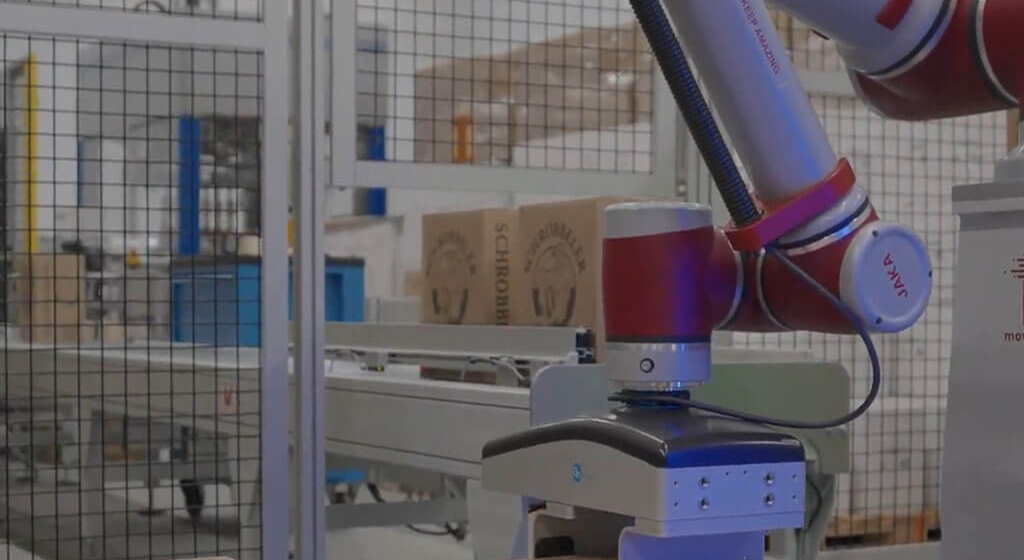
Task: The cobot feeds products into a machine or station and removes finished ones.
Requirements:
- Raise efficiency and quality.
- Redeploy the line quickly for flexible machine tending.
- Use simple programming to replace manual labor.
Solution: JAKA Zu7, JAKA Zu12, JAKA Zu18, JAKA Zu20, JAKA Zu30 and JAKA MiniCobo (1 kg, 580 mm) for very light items.
Can a Cobot Sort Products?
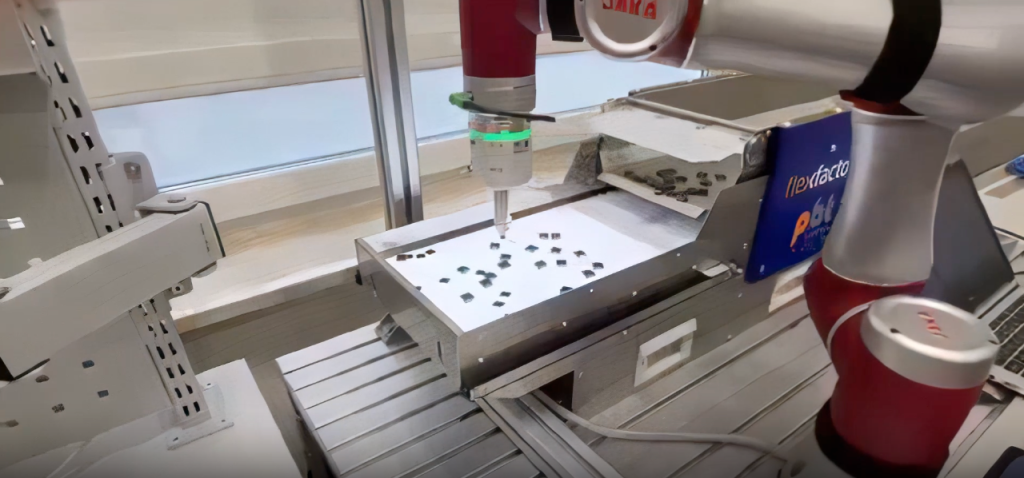
Task: The cobot sorts products by type or by result, for example after a camera has returned a pass or fail.
Requirements:
- Keep yield and quality stable, which manual operation does not guarantee.
- Adapt to diverse production needs without new specialized equipment.
- Work safely in a shared human-robot space.
Solution: JAKA Mini 2 (2 kg, 580 mm) and JAKA MiniCobo. Browse the JAKA Mini series.
Can a Cobot Drive Screws on Consumer Products?
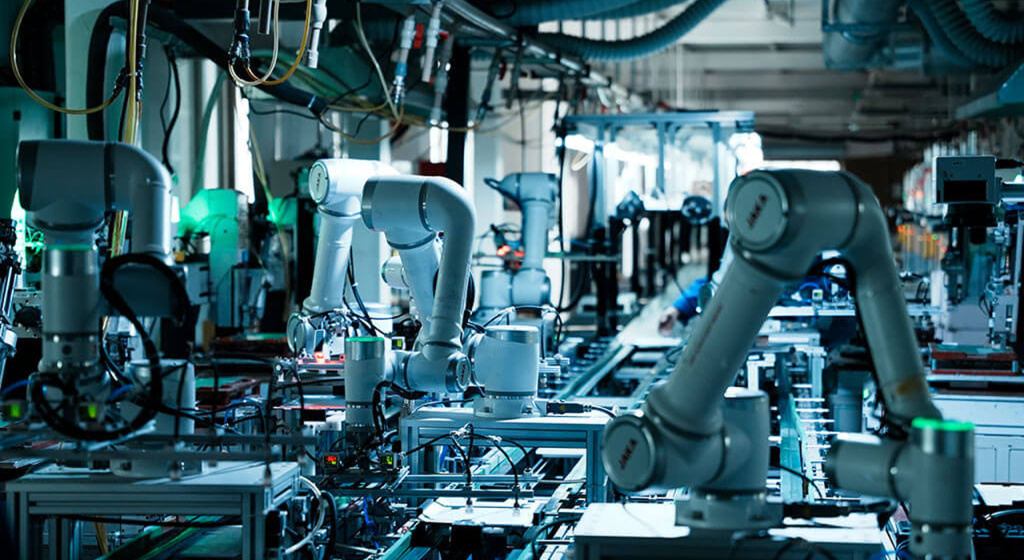
Task: The cobot drives screws at a set torque on each product.
Requirements:
- Deliver consistent output on repetitive, tedious work.
- Fit compact, flexible production that is easy to deploy.
- Redeploy the cobot easily when production needs change.
Solution: JAKA Zu3 (3 kg, 626 mm), JAKA Zu5 (5 kg, 954 mm) and JAKA Zu7.
Which JAKA Cobot Fits Which Consumer Goods Task?
|
Task |
JAKA models |
|---|---|
| Packing | Zu7, Zu12, Zu18, Zu20, Zu30 |
| Palletizing | Zu12, Zu20, Zu30 |
| Loading and unloading | Zu7, Zu12, Zu18, Zu20, Zu30, MiniCobo |
| Sorting | Mini 2, MiniCobo |
| Screw driving | Zu3, Zu5, Zu7 |
How Do You Start a Consumer Goods Automation Project?
Start with one product line and one measurable problem, then expand. The same steps apply to automation solutions for the retail consumer goods industries and to any other packaged product.
- Define the failure to prevent. Examples are a misprinted code, a wrong color, a damaged edge or manual lifting.
- Pick the task type. Checking and reading point to Hikrobot. Packing, stacking, sorting and screw driving point to a JAKA cobot.
- Check the physical limits. For vision, note product size, finish, speed and mounting space. For a cobot, note product weight, reach and tooling.
- Test on real products. Run good and bad samples under production lighting.
- Add safety and data. Plan guarding, PLC communication and where results are stored. To size the payoff, read how to calculate machine vision ROI.
For comparison, our food and beverage guide shows the same method on bottles, caps and cartons. Share your product, line speed and goal when you ask ELVOTEC for a recommendation.