
Food and beverage
Food and Beverage Automation Solutions
Short answer: Food and beverage automation uses machine vision, robots and cobots to inspect packaging, read printed data, count products and move cartons with less manual work. Hikrobot smart cameras check labels, print, counts and caps on the line. JAKA cobots handle loading and unloading, packing and palletizing.
Why Does Automation for Food and Beverage Matter?
Food lines run fast and pack many similar products. A wrong label, a faint date code, a missing cap or a miscounted pack is easy to miss by eye and costly to find later.
Robots are still a small part of this sector. The International Federation of Robotics puts the food and beverage industry at 4% of 2024 industrial robot installations. That is a small share, and cobots lower the barrier for lines that have not yet automated.
What Does Automation in the Food Processing Industry Include?
Automation in the food processing industry means machines that inspect, handle and pack products with little manual input. In practice it has four parts:
- Inspection: cameras check labels, caps and counts.
- Identification: OCR reads printed text and codes.
- Handling: cobots feed machines, pack and palletize.
- Safety: lidar and light curtains guard the robot cell.
Cameras and cobots can be added to automated food processing equipment such as conveyors and packing stations, so you do not have to replace the whole line.
Which Brands Can You Use for Food and Beverage Industrial Automation?
ELVOTEC integrates several brands that cover the main tasks in food and beverage industrial automation:
- Hikrobot: machine vision for inspection, counting and text reading.
- JAKA: collaborative robots for machine tending, packing and palletizing.
- DH-Robotics: electric grippers for the robot end.
- SDKELI and Akusense: safety lidar and light curtains for guarding the cell.
Food process automation covers several jobs. The table shows which technology fits each.
|
Job |
Typical technology |
|---|---|
| Read print and labels | Hikrobot smart cameras with OCR |
| Count and inspect on a conveyor | Hikrobot smart cameras |
| Feed and empty machines | JAKA cobots |
| Pack and palletize | JAKA cobots, with DH-Robotics grippers |
New to the technology? Start with what machine vision is.
Machine Vision Applications in Food and Beverage Industry
Machine vision here means cameras and software that check packages on the line and decide pass or fail automatically. The five cases below follow Hikrobot’s own application cases for the food industry. For the quality side, see how machine vision improves quality control.
What Are OCR and a Smart Camera?
OCR (optical character recognition) reads printed characters from an image and turns them into text. A smart camera combines the image sensor, processor and vision software in one unit, so it can run the check and send the result on its own. Most cases below use smart cameras with OCR or counting tools.
How Does a Smart Camera Grade Fruit Boxes and Read Labels?
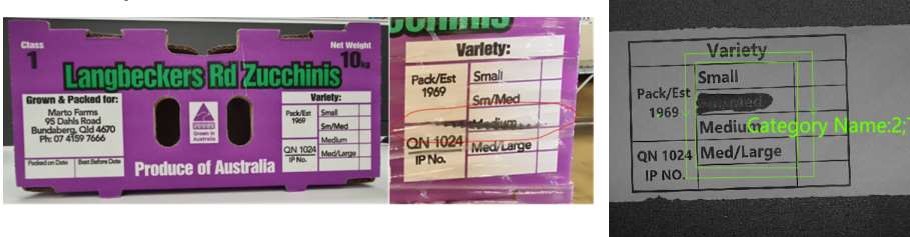
Task: The camera reads the variety printed on one side of the box (Small, Sm/Med, Medium or Med/Large) and the label numbers on the other. The boxes travel on a conveyor and the camera sits above it.
Requirements:
- Recognize the variety on the right side of the box.
- Read the printed label numbers on the left side.
- Handle three different label types.
- Work on boxes moving on a conveyor.
Solution:
- MV-SC7060: OCR works without training. Recognizing the variety marks uses deep learning, which needs extra training.
This is a smart camera with built-in vision tools. If you are unsure whether you need one, read what a smart camera is.
How Does Machine Vision Read Printing on Rice Packages?
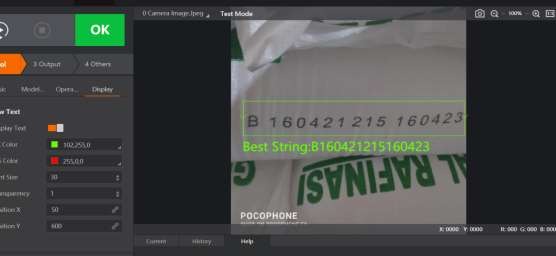
Task: The camera reads the printed characters on rice bags. Many package designs mean many backgrounds, and the bags are wrinkled.
Requirements:
- Run OCR on the rice packages.
- Cover a field of view 29 cm wide.
- Read characters 8 mm wide.
- Cope with different backgrounds and wrinkles.
Solution:
- MV-SC7060: OCR is possible without extra training.
Hikrobot lists these advantages for this case: the camera and lens can be replaced flexibly, several solutions can be saved for different models, and multiple communication protocols are available for PLCs and other third-party interfaces.
How Does a Smart Camera Count Bottles and Inspect Labels?
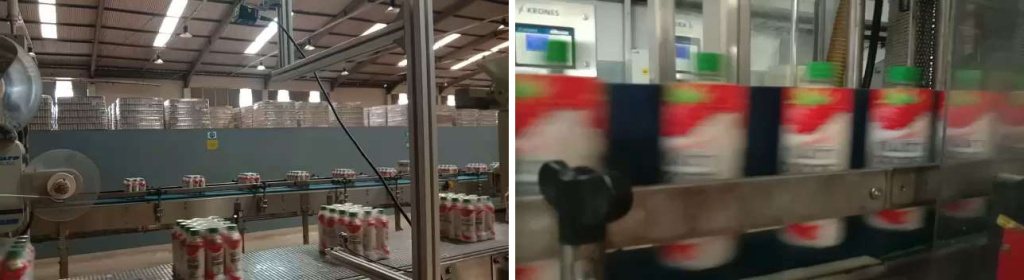
Task: The camera counts the bottles in a pack on a conveyor and inspects the label on every bottle at high speed.
Requirements:
- Count the bottles in each package.
- Inspect each bottle’s label at high speed.
- Support an outside trigger.
Solution:
- MV-SC3000: Hikrobot notes that no extra light source is needed in this case.
Where a line does need added light, check the light sources and controllers.
How Does Machine Vision Check Dot-Print Characters on Packaging?

Task: The camera reads dot-print characters on chocolate packages moving on a belt and verifies them.
Requirements:
- Check dot-print characters.
- Work on packages on a conveyor belt.
- Support an external trigger.
Solution:
- MV-SC3000: the camera used in Hikrobot’s chocolate package case.
Hikrobot says the SC3000 integrates more than 30 detection algorithms, including AI character recognition and code reading. It shows packaging code checks as one use.
How Does a Smart Camera Inspect Bottle Caps on a Fast Line?
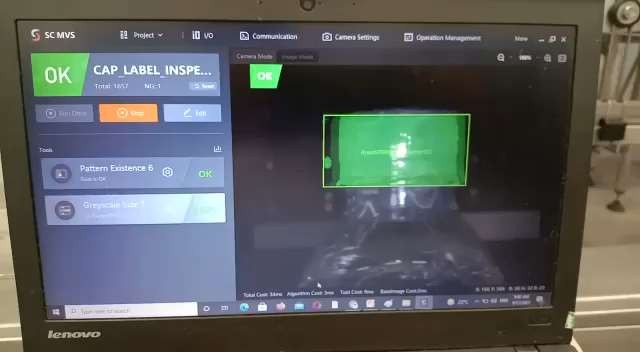
Task: The camera checks each cap on bottles moving on a high-speed conveyor. Hikrobot’s case uses a pattern existence tool and a greyscale size tool.
Requirements:
- Check every bottle cap.
- Keep up with a high-speed conveyor.
- Support an external trigger.
Solution:
- MV-SC3000: the camera used in Hikrobot’s bottle cap case.
For very fast lines, compare sensor types in area scan vs line scan cameras.
Which Hikrobot Camera Fits Which Food Task?
Use this summary to match the task to the camera used in Hikrobot’s cases.
|
Task |
Camera |
Main challenge |
|---|---|---|
| Fruit box grading and label reading |
MV-SC7060 |
Three label types on a moving conveyor |
| Rice package printing | MV-SC7060 | Wrinkles and varied backgrounds |
| Bottle counting and label check | MV-SC3000 | High speed and an outside trigger |
| Dot-print characters | MV-SC3000 | Dot print on a moving belt |
| Bottle cap check | MV-SC3000 | High-speed conveyor |
Hikrobot’s cases list multiple communication protocols for connecting to PLCs and other third-party interfaces, so the results can feed the rest of the line.
JAKA Cobots for Food and Beverage Industry
Robots in the food industry often do simple, repeated moves: lift, place, pack, stack. Cobots suit these tasks because they work beside people and are reprogrammed for new products. A single robot in the food industry can also serve several lines, as JAKA notes for palletizing. If the term is new, read what a collaborative robot is.
JAKA lists three food and beverage scenarios. The models below come from the typical applications on each JAKA product page. The final choice depends on payload, reach and tooling, and this comparison of JAKA cobot series can help.
Can a Cobot Handle Loading and Unloading in Food Production?
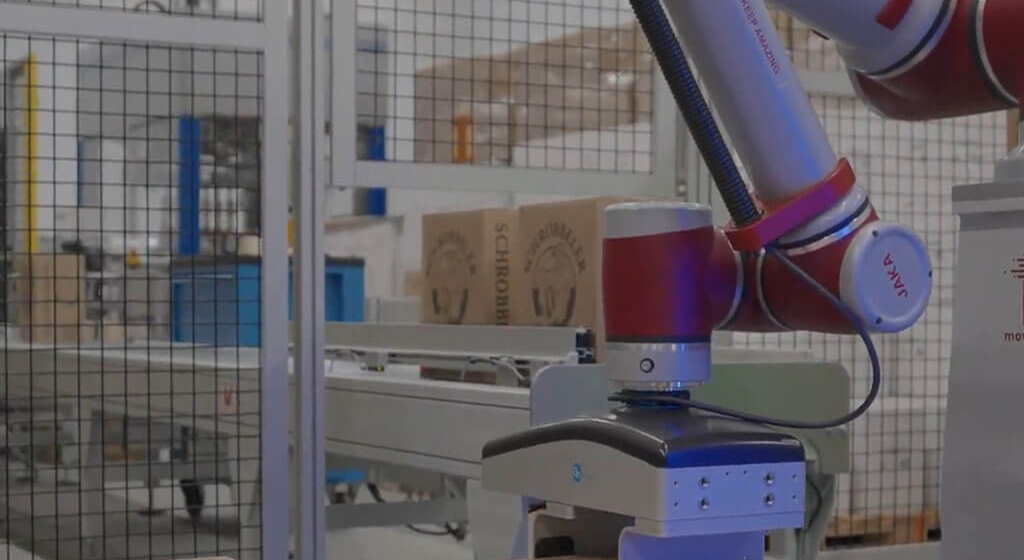
Task: The cobot feeds parts or products into a machine and removes finished ones.
Requirements:
- Raise efficiency and product quality.
- Redeploy the line quickly for efficient, flexible machine tending.
- Use simple programming to replace manual labor.
Solution: JAKA Zu7 (7 kg payload, 819 mm reach), JAKA Zu12 (12 kg, 1,327 mm), JAKA Zu18 (18 kg, 1,073 mm), JAKA Zu20 (20 kg, 1,780 mm), JAKA Zu30 (30 kg, 1,350 mm) and JAKA MiniCobo (1 kg, 580 mm) for very light items.
Can a Cobot Do Packing in Food and Beverage Plants?
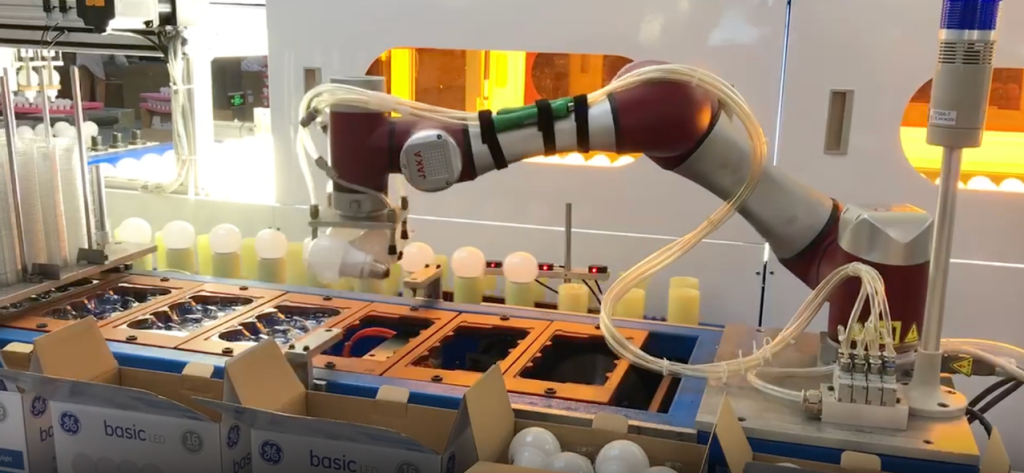
Task: Packing means placing products or cartons into packs and cases. The cobot takes over this repeated handling step beside the line.
Requirements:
- Repeat each move precisely to protect product quality and reduce scrap.
- Replace manual labor and reduce management costs.
- Raise the production rate.
Solution: JAKA Zu7, JAKA Zu12, JAKA Zu18, JAKA Zu20 and JAKA Zu30, all listed for packing. Pair them with DH-Robotics electric grippers chosen for the product.
Can a Cobot Palletize Food and Beverage Products?
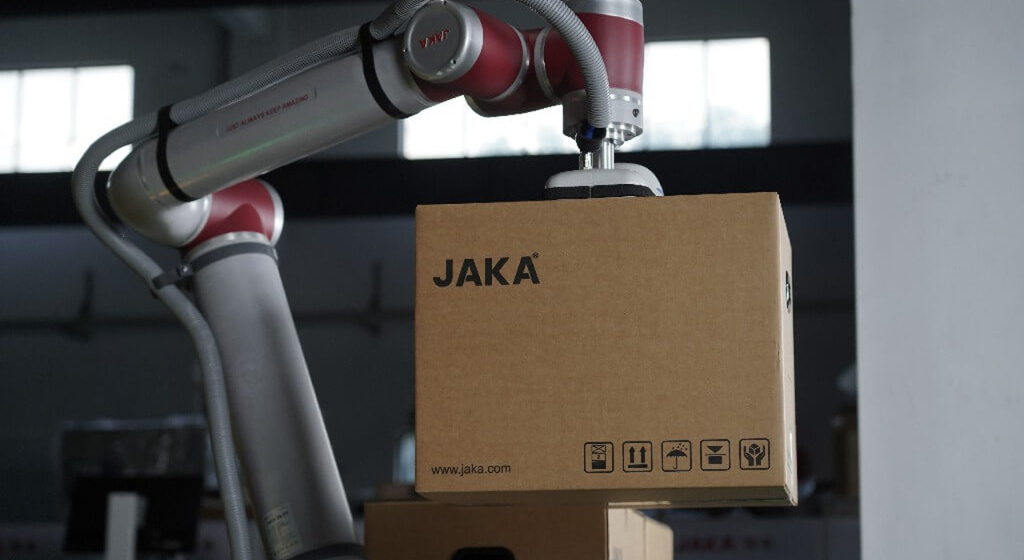
Task: Palletizing means stacking cartons or cases on a pallet for shipping. The cobot does this at the end of the line, so staff no longer lift each case by hand.
Requirements:
- Automate palletizing, raise efficiency and improve the operators’ working environment.
- Fit a compact, lightweight robot into a small footprint.
- Let one robot serve several production lines.
Solution: JAKA Zu12, JAKA Zu20 and JAKA Zu30. Browse the full JAKA Zu series and the lighter JAKA Mini series. Guard the cell with SDKELI safety lidar where the risk assessment calls for it.
Which JAKA Cobot Fits Which Food Task?
|
Task |
JAKA models |
|---|---|
| Loading and unloading | Zu7, Zu12, Zu18, Zu20, Zu30, MiniCobo |
| Packing | Zu7, Zu12, Zu18, Zu20, Zu30 |
| Palletizing | Zu12, Zu20, Zu30 |
Can Cameras and Cobots Work Together on One Line?
Yes. A camera can check a label, cap or count before a cobot packs or stacks the product, and both report to the line’s PLC. Treat them as two stations on one line, each with its own task and its own safeguards.
How Do You Start a Food and Beverage Automation Project?
Start with one station and one measurable problem, then expand.
- Define the failure to prevent. Examples are an unreadable date code, a wrong label, a missing cap or a manual lifting task.
- Pick the task type. Reading, counting and checking point to Hikrobot. Feeding, packing or stacking points to a JAKA cobot.
- Check the physical limits. For vision, note field of view, character size, speed and trigger. For a cobot, note load, reach and tooling.
- Test on real products. Run good and bad samples at line speed.
- Add safety and data. Plan guarding, PLC communication and where results are stored.
Related sectors use the same approach, as in our pharmaceutical and electronics automation guides. Share your product, line speed and goal when you ask ELVOTEC about automation solutions for food and beverage manufacturing.