
Logistics
Logistics Automation Solutions
Short answer: Logistics automation uses machine vision, robots and cobots to scan, measure, sort and move parcels and pallets with fewer manual steps. Hikrobot cameras and code readers handle scanning, dimensioning, singulation and sort checks. JAKA cobots handle palletizing, packing, sorting and loading and unloading.
Why Does Logistics Automation Matter?
Parcels arrive in mixed shapes, sizes and materials, and sorters run non-stop. A missed label, a double parcel or an empty slot on the belt becomes a mis-sort further down the line.
Hikrobot’s logistics vision brochure gives a sense of the gap. Its singulation system is rated at up to 7,000 parcels per hour (pph), against about 2,000 pph for the system manual. Its dynamic dimensioning, weighing and scanning system is rated above 5,000 pph, against 1,000 pph for manual equipment.
What Is Machine Vision for Logistics & Warehousing?
Machine vision for logistics & warehousing means cameras, code readers and software that identify, locate and measure goods without human input. It reads labels, finds parcel position, checks spacing and measures size, then passes the result to the sorter or the warehouse system.
This is the core of machine vision for logistics automation. If you are new to the technology, start with what machine vision is.
Which Brands Can You Use for Logistics Automation?
ELVOTEC integrates several brands that cover the main tasks:
- Hikrobot: machine vision for code reading, 3D measurement and parcel checks.
- JAKA: collaborative robots for palletizing, packing and sorting.
- DH-Robotics: electric grippers for the robot end.
- SDKELI and Akusense: safety lidar and light curtains for guarding the cell.
The table shows which technology fits each job.
|
Job |
Typical technology |
|---|---|
| Read labels on moving parcels | Hikrobot code readers |
| Measure parcel size and position | Hikrobot 3D cameras |
| Check belts for empty or double parcels | Hikrobot RGB-D smart cameras |
| Stack, pack and sort | JAKA cobots, with DH-Robotics grippers |
Machine Vision Applications in Logistics Industry
The five cases below follow Hikrobot’s logistics brochure. Each shows the task, the requirements and the Hikrobot models listed for it. For the quality side of vision, see how machine vision improves quality control.
Package Classification

Requirements:
- Classifying packages into four types: carton, foam box, woven
box and plastic bag. - The required recognition accuracy must exceed 99%.
- Camera: MV-SC7016C
- Algorithm Tool: DL Classification
How Does Machine Vision Weigh, Measure and Scan Parcels in One Pass?
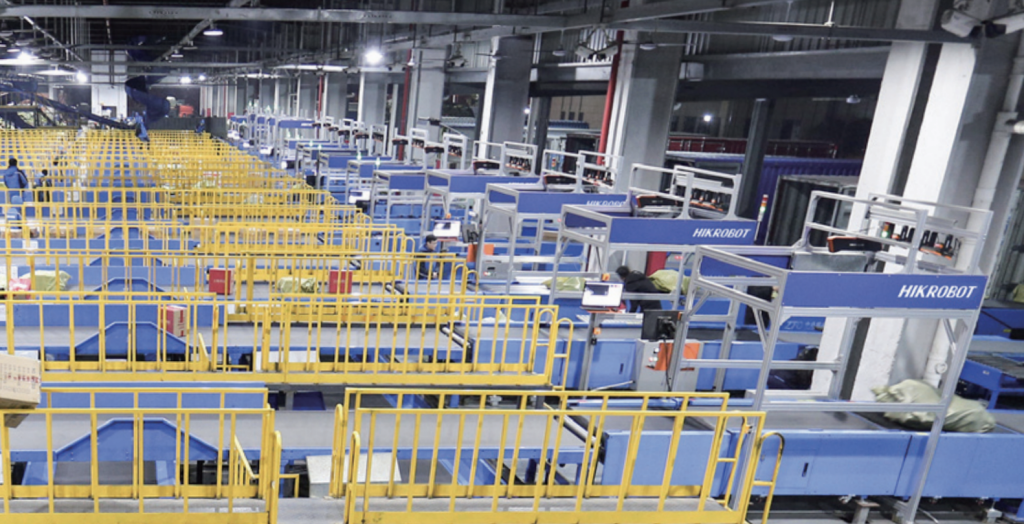
Task: This is a dynamic DWS system. DWS stands for dimensioning, weighing and scanning. It captures the barcode, volume and weight of each parcel while the parcel keeps moving.
Requirements:
- Capture barcode, volume and weight in non-stop transport.
- Raise an alarm for overlong, overweight or unlabeled parcels.
- Save data and images locally or upload them to a server.
Hikrobot gives these figures: a rate above 5,000 pph against 1,000 pph for manual equipment, weighing accuracy of ±40 g and volume accuracy of ±5 mm.
Solution:
- MV-ID6200M-00C-NNG: 20 MP logistics code reader, 12 per system.
- MV-ID7080EM-35F-WHA: 8K line scan camera.
- MV-DL2125-04H-R: line laser 3D camera.
- MV-PD010003-12C-8C: logistics code reading set.
- MV-VC3501H-128G60: vision controller.
Browse the line laser 3D cameras and use a vision controller to process several cameras together. To see why a line scan camera suits moving parcels, read area scan vs line scan cameras.
How Does Machine Vision Read Barcodes on Every Side of a Moving Parcel?
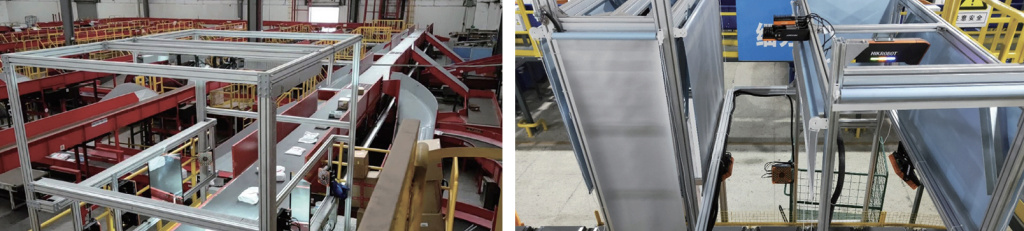
Task: Readers around the conveyor decode the label wherever it lands on the parcel, so staff do not have to turn parcels by hand.
Requirements:
- Read barcodes on all six faces of a moving parcel.
- Keep manual reorientation to a minimum.
- Cover the field of view and depth of field on cross-belt sorters.
Hikrobot’s six-sided system uses five ID6000 readers, one ID7000 line scan reader and an RGB-D camera. It adds an optional bottom reflector and optional automatic mirror cleaning. Its cross-belt system lists a depth of field above 400 mm.
Solution:
- MV-ID6200M-00C-NNG: 20 MP smart code reader, 5 in the six-sided system.
- MV-ID7080EM-35F-WHA: 8K line scan camera.
- MV-DB500S-C: RGB-D smart camera.
- MV-ID6120PM-00C-NNG: 12 MP smart code reader, 8 in the cross-belt system.
Good reads depend on good light, so check the light sources and controllers.
How Does Machine Vision Singulate Parcels Before the Sorter?
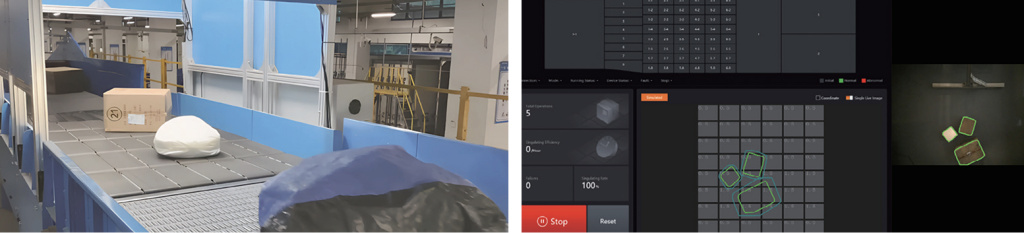
Task: Singulation means separating parcels so they reach the sorter one at a time with a gap between them. RGB-D cameras combine 2D deep-learning segmentation with 3D data to find each parcel and drive the belt actuators.
Requirements:
- Separate dense, black, envelope, same-color and sealed-bag parcels.
- Keep a steady interval between parcels.
- Adapt to different singulator sizes by changing the camera count.
Hikrobot lists up to 7,000 pph against about 2,000 pph for the system manual, an interval error of ±10% and a singulation accuracy of 99.9%.
Solution:
- MV-DB500S-S: RGB-D smart camera, 2 to 3 per system.
- iMVS-MV3D-SCS: dongle.
- MV-VC3101H-128G60: vision controller.
See the RGB-D smart 3D cameras range. A smart camera runs its checks on board, which keeps the station compact.
How Does Machine Vision Detect Empty, Double and Misplaced Parcels on a Sorter?
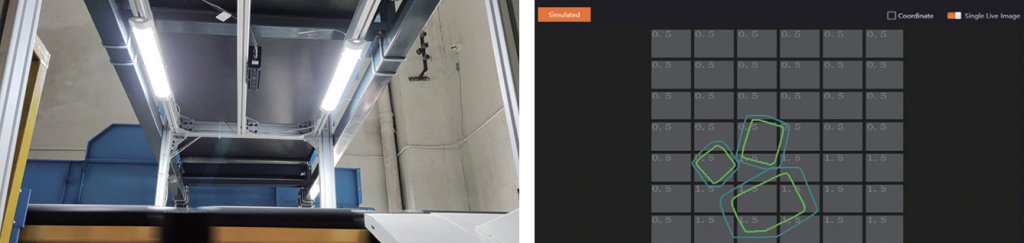
Task: EDP stands for empty, double and position. One camera over the sorter spots empty positions, double parcels, position errors and parcels over the belt edge. It works on cross-belt, tilting, balance-wheel and narrow-belt sorters.
Requirements:
- Detect empty positions, double parcels and position errors.
- Handle cartons, soft packages, envelopes and woven bags.
- Process each frame fast enough for a moving sorter.
Hikrobot lists processing under 150 ms, empty-detection accuracy above 99.9% and a maximum speed of 3.5 m/s.
Solution:
- MV-DB500S-C: RGB-D smart camera.
For mis-sort tracking at cross belts, Hikrobot’s brochure recommends the MV-SC3000 smart camera with a vision controller.
How Does a Code Reading Gate Scan Whole Pallets?
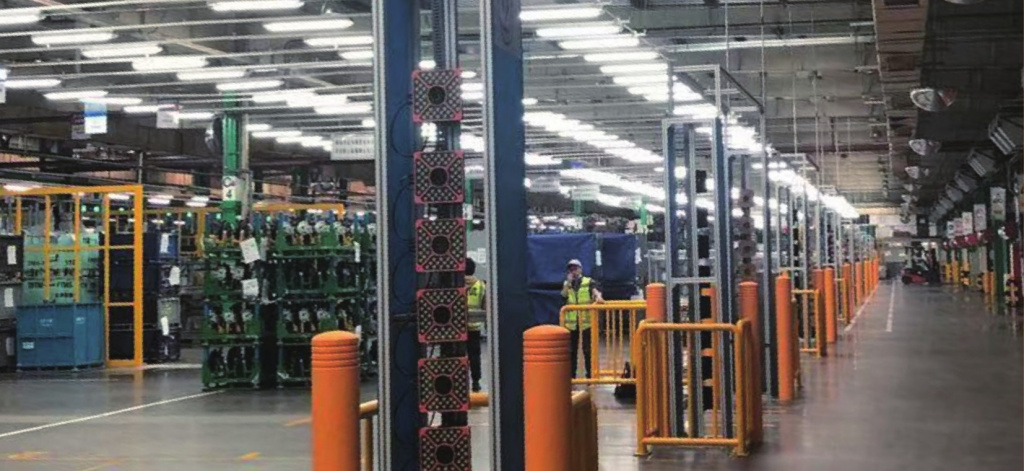
Task: Cameras on a gate scan the labels on an entire pallet as it passes, during palletizing or inspection.
Requirements:
- Scan whole pallets without slowing transit.
- Catch missed labels.
- Work around the clock.
Hikrobot compares three methods:
|
Method |
Scanning time |
Result |
|---|---|---|
| Manual scanning with a PDA | 3 to 5 minutes per pallet | High risk of missed scans |
| RFID | 5 to 10 seconds per pallet | Prone to interference, cannot detect missed reads |
| Code reading gate | 5 to 10 seconds per pallet | High recognition rate, with code supplementation for missed reads |
Solution:
- MV-ID6120PM-HVS: 12 MP logistics code reading camera, 2 to 10 per gate.
- MV-ID6200M-HVS: 20 MP logistics code reading camera, 2 to 10 per gate.
Which Hikrobot Solution Fits Which Logistics Task?
|
Task |
Key Hikrobot models |
Main benefit |
|---|---|---|
| Dimensioning, weighing, scanning | MV-ID6200M-00C-NNG, MV-DL2125-04H-R | One pass for code, volume and weight |
| Code reading on all sides | MV-ID6200M-00C-NNG, MV-ID6120PM-00C-NNG | No manual turning |
| Singulation | MV-DB500S-S | 99.9% singulation accuracy |
| Empty, double, position check | MV-DB500S-C | Under 150 ms per frame |
| Pallet scanning | MV-ID6120PM-HVS, MV-ID6200M-HVS | 5 to 10 seconds per pallet |
JAKA Cobots for Logistics Industry
Cobots take over the repeated lifting and placing that follows vision. They work beside people and are reprogrammed for new products. If the term is new, read what a collaborative robot is.
JAKA’s application scenarios include palletizing, packing, sorting and loading and unloading. The models below come from the typical applications on each JAKA product page. The final choice depends on payload, reach and tooling, and this comparison of JAKA cobot series can help.
Can a Cobot Palletize Cartons and Cases?
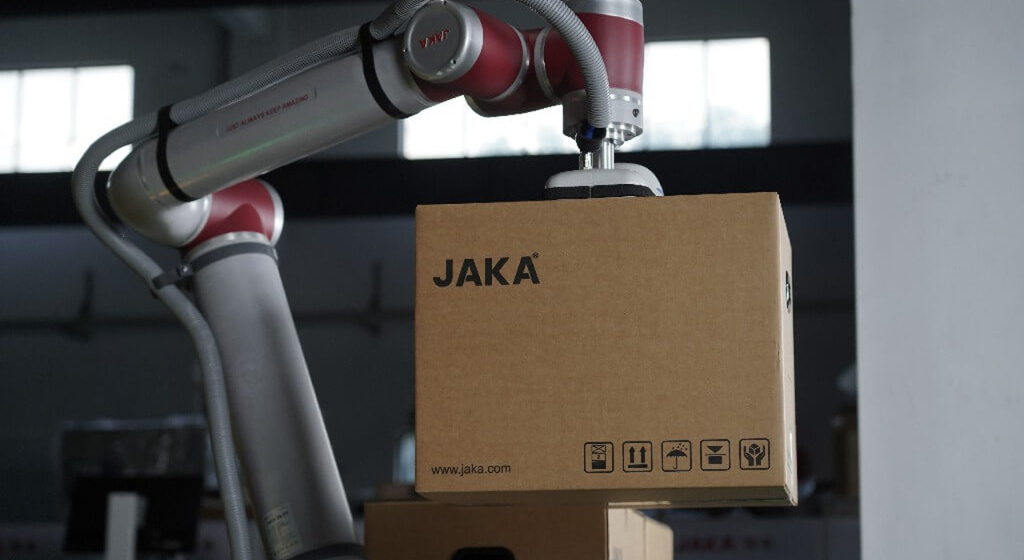
Task: Palletizing means stacking cartons or cases on a pallet for shipping. The cobot does this at the end of the line.
Requirements:
- Automate palletizing, raise efficiency and improve the operators’ working environment.
- Fit a compact, lightweight robot into a small footprint.
- Let one robot serve several production lines.
Solution: JAKA Zu12 (12 kg payload, 1,327 mm reach), JAKA Zu20 (20 kg, 1,780 mm) and JAKA Zu30 (30 kg, 1,350 mm). JAKA describes the Zu30 as designed for heavy objects in limited space. Guard the cell with SDKELI safety lidar where the risk assessment calls for it.
Can a Cobot Pack Orders and Parcels?
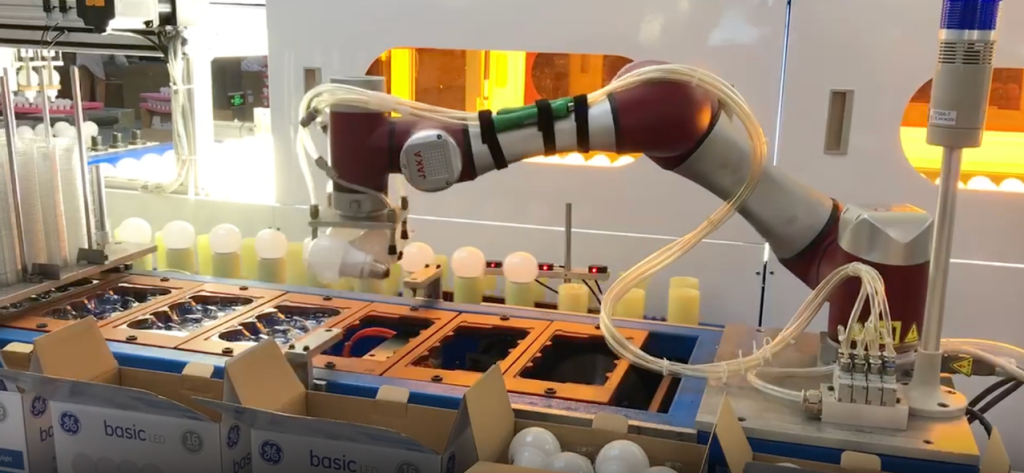
Task: Packing means placing items or cartons into boxes and cases. The cobot takes over this repeated handling step.
Requirements:
- Repeat each move precisely to protect quality and reduce scrap and rework.
- Replace manual labor and reduce management costs.
- Raise the production rate.
Solution: JAKA Zu7 (7 kg, 819 mm), JAKA Zu12, JAKA Zu18 (18 kg, 1,073 mm), JAKA Zu20 and JAKA Zu30, all listed for packing. Pair them with DH-Robotics electric grippers chosen for the item.
Can a Cobot Sort Items?
Task: The cobot sorts items by type or by result, for example after a camera has read the code.
Requirements:
- Reprogram quickly for different items.
- Keep precision consistent and lower the defect rate.
- Replace manual operators in repetitive sorting.
Solution: JAKA Mini 2 (2 kg, 580 mm) and JAKA MiniCobo (1 kg, 580 mm). Browse the JAKA Mini series.
Can a Cobot Handle Loading and Unloading?
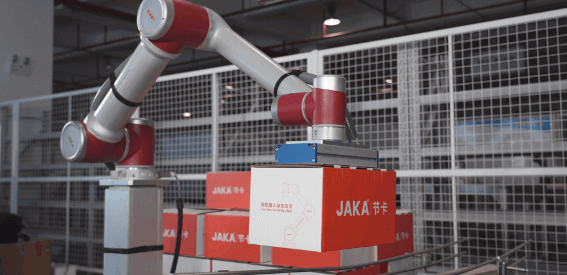
Task: The cobot loads items into a machine or station and removes them.
Requirements:
- Raise efficiency and quality.
- Redeploy the line quickly.
- Use simple programming to replace manual labor.
Solution: JAKA Zu7, JAKA Zu12, JAKA Zu18, JAKA Zu20, JAKA Zu30 and JAKA MiniCobo. See the full JAKA Zu series.
Which JAKA Cobot Fits Which Logistics Task?
|
Task |
JAKA models |
|---|---|
| Palletizing | Zu12, Zu20, Zu30 |
| Packing | Zu7, Zu12, Zu18, Zu20, Zu30 |
| Sorting | Mini 2, MiniCobo |
| Loading and unloading | Zu7, Zu12, Zu18, Zu20, Zu30, MiniCobo |
How Do You Start a Logistics Automation Project?
Start with one station and one measurable problem, then expand.
- Define the failure to prevent. Examples are missed labels, double parcels, slow manual scanning or manual lifting.
- Pick the task type. Scanning, measuring and checking point to Hikrobot. Stacking, packing and sorting point to a JAKA cobot.
- Check the physical limits. For vision, note parcel types, belt speed and field of view. For a cobot, note load, reach and tooling.
- Test on real goods. Run good and bad samples at line speed.
- Add safety and data. Plan guarding, PLC communication and where results are stored.
The same approach works in other sectors, as in our food and beverage and automotive guides. Share your parcels, belt speed and goal when you ask ELVOTEC for a recommendation.