
Pharmaceutical
Pharmaceutical Manufacturing Automation Solutions
Short answer: Automation in the pharmaceutical industry uses machine vision and cobots to inspect products, read codes, record data and handle packs with fewer manual steps. Hikrobot cameras and code readers check capsules, labels, Data Matrix codes and test tubes. JAKA cobots take over loading and unloading, packing and sorting.
Why Does Automation in the Pharmaceutical Industry Matter?
Drugs must be made, handled and packaged under tight rules. In the US, FDA’s CGMP regulations set minimum requirements for the methods, facilities and controls used in this work. Automation in pharmaceutical manufacturing supports that goal in a practical way: a camera applies the same check to every item, and a robot repeats the same move every cycle.
The cases below share one pattern. Each one needs a clear OK or NG decision, a record of what was checked and a link to the PLC. Hikrobot lists these as built-in strengths: OK/NG output goes straight to a PLC, indicator or buzzer, and solutions can be saved for different models.
What Is Pharmaceutical Manufacturing Automation?
Pharmaceutical manufacturing automation means using cameras, robots and cobots to inspect and move products on drug production and packaging lines. It covers the physical side of the process, from the capsule to the carton.
Robotic process automation in the pharmaceutical industry is a related term. It usually refers to software that automates office tasks. This page covers the production floor instead: machine vision and cobots at the station. New to the technology? Start with what machine vision is.
Which Brands Can You Use for Automation in the Pharmaceutical Industry?
ELVOTEC integrates several brands that cover the main tasks:
- Hikrobot: machine vision for inspection, code reading and OCR.
- JAKA: collaborative robots for repetitive handling, packing and sorting.
- DH-Robotics: electric grippers for the robot end.
- SDKELI and Akusense: safety lidar and light curtains for guarding the cell.
The table shows which technology fits each job.
|
Job |
Typical technology |
|---|---|
| Check capsule cutting | Hikrobot smart cameras |
| Read Data Matrix codes on boxes | Hikrobot code readers |
| Read printed text on labels | Hikrobot area scan camera with Vision Master software |
| Read, measure and classify test tubes | Hikrobot smart cameras |
| Feed, pack and sort | JAKA cobots, with DH-Robotics grippers |
Machine Vision Applications in the Pharmaceutical Industry
Machine vision for the pharmaceutical industry means cameras and software that inspect, read and measure products, then return a result to the line. The four cases below follow Hikrobot’s smart product application cases and its pharmaceutical page. They use smart cameras, barcode readers and area scan cameras. For the quality side of vision, see how machine vision improves quality control.
How Does Machine Vision Inspect Capsule Cutting on a Running Line?
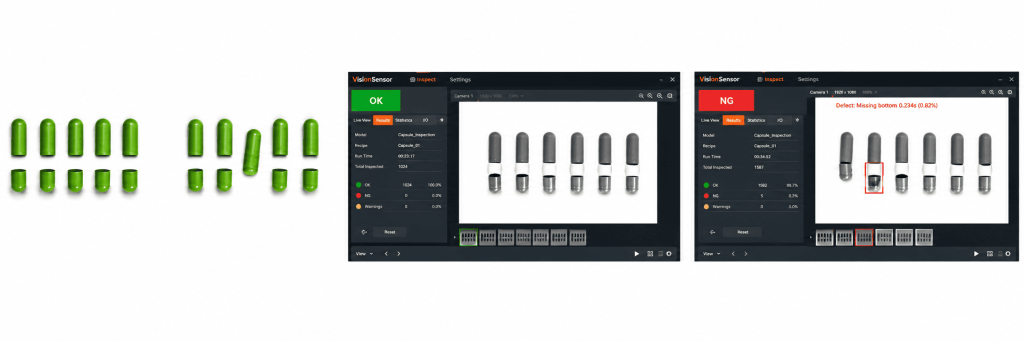
Task: The camera checks that capsules are cut properly. They are aligned across a large field of view with set spacing between them.
Requirements:
- Recognize proper cutting of the capsules.
- Cover a large field of view.
- Inspect on a running line.
- Map the relationship between speed and accuracy.
Hikrobot lists these advantages: OK/NG discrete output goes directly to a PLC, indicator or buzzer, solutions can be saved for different models, and no other algorithm or process needs to run to produce the result. Hikrobot’s example screen shows both OK and NG results.
Solution:
- MV-SC2016PM: smart camera. Several units are used to cover the full required field of view.
How Does Machine Vision Read Data Matrix Codes on a Whole Package of Boxes?
Task: A Data Matrix is a 2D code. Here, one code reader recognizes and records the Data Matrix code of every small box in a 600 × 400 mm package at one time.
Requirements:
- Recognize the Data Matrix code on each small box.
- Record every code in one reading.
- Read the whole 600 × 400 mm package at one time.
Solution:
- MV-ID6200M: smart code reader from the ID6000 series. Its listed resolution is 5440 × 3648 pixels (20 MP), and it supports Data Matrix and other 2D codes.
For more on reading and tracing codes, read the guide to machine vision code reading for traceability.
How Does Machine Vision Read Text on a Medicine Box Label?

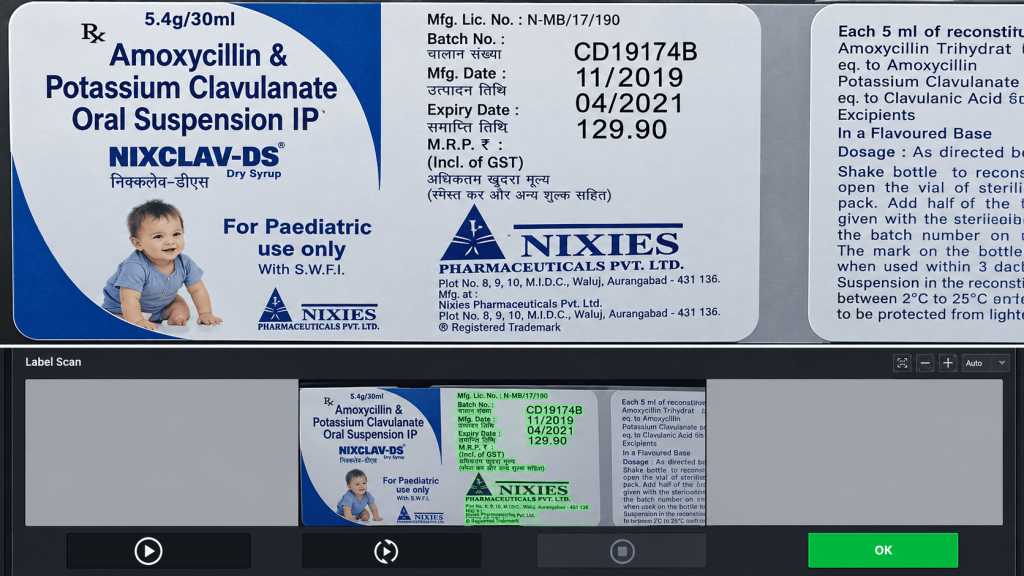
Task: OCR stands for optical character recognition. The camera reads several lines of text on a medicine box label, such as batch number and dates, and passes the result to a custom interface.
Requirements:
- Run OCR on the medicine box.
- Recognize multiple lines of characters.
- Provide a self-defined interface.
- Work without deep learning.
Hikrobot lists these advantages: equipment such as the camera and lens can be replaced flexibly, solutions are saved for different models, and several protocols connect the camera to a PLC or a third-party system.
Solution:
- MV-CA050-10GM: area scan camera.
- Vision Master: software.
Text on curved or glossy packs depends on stable light, so see how to choose a machine vision lens and lighting. Browse the Hikrobot lens range for the station.
How Does Machine Vision Classify Test Tubes?
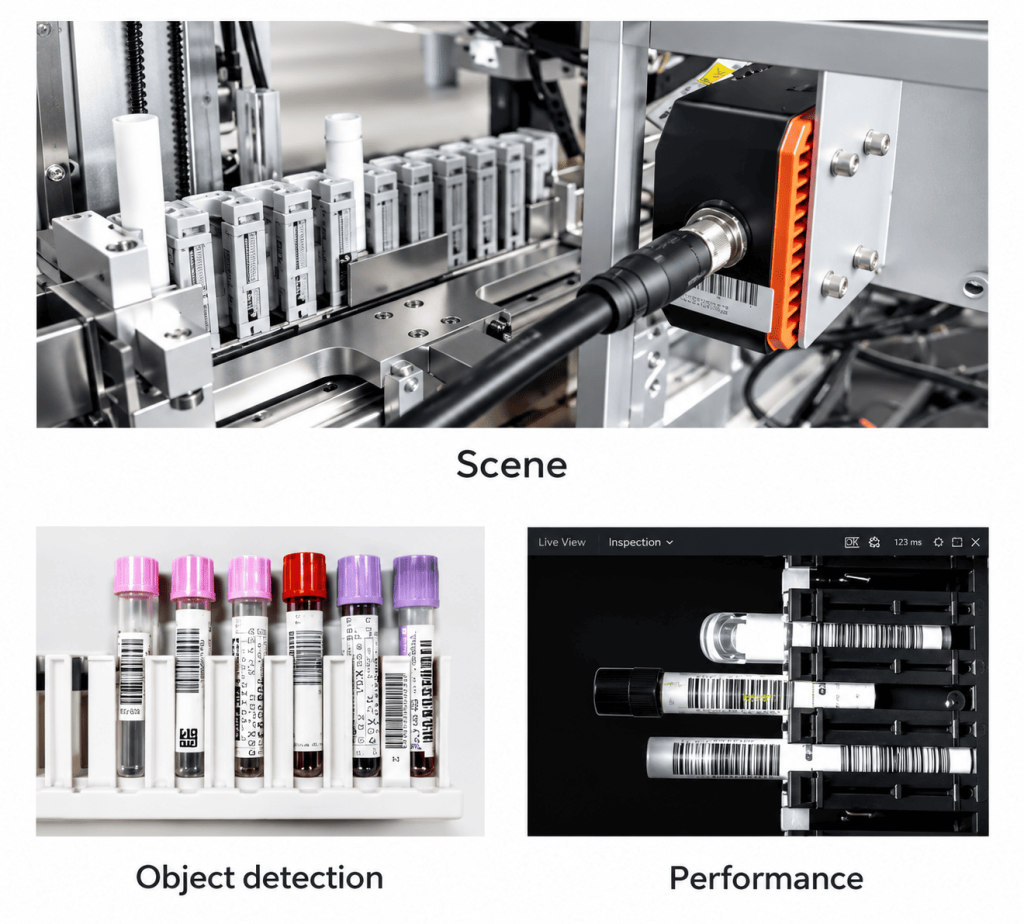
Task: The camera reads the code on each test tube, measures its size and judges its category.
Requirements:
- Read the code information on the test tubes.
- Measure the size of the test tubes.
- Judge the category.
Solution:
- MV-SC2016PC / SC3016PC: smart cameras.
- Algorithm tools: code reading, width measurement, line finding and blob analysis.
A smart camera runs these tools on board, which keeps the station compact.
Which Hikrobot Camera Fits Which Pharmaceutical Task?
|
Task |
Camera |
Software tools |
|---|---|---|
| Capsule cut inspection | MV-SC2016PM | Multiple units for a large field of view |
| Data Matrix on boxes | MV-ID6200M | Code reading |
| Medicine box OCR | MV-CA050-10GM | Vision Master |
| Test tube classification | MV-SC2016PC / SC3016PC | Code reading, width measurement, line finding, blob analysis |
JAKA Cobots for Pharmaceutical Industry
A cobot is a collaborative robot designed to work beside people. If the term is new, read what a collaborative robot is.
JAKA’s industry pages do not include a separate pharmaceutical segment. The three scenarios below are JAKA’s general ones, and they suit pharmaceutical lines that feed, pack and sort small items. The models come from the typical applications on each JAKA product page. Final choice depends on payload, reach, tooling and the cleanliness rules of your line, and this comparison of JAKA cobot series can help.
Can a Cobot Handle Loading and Unloading on a Pharma Line?
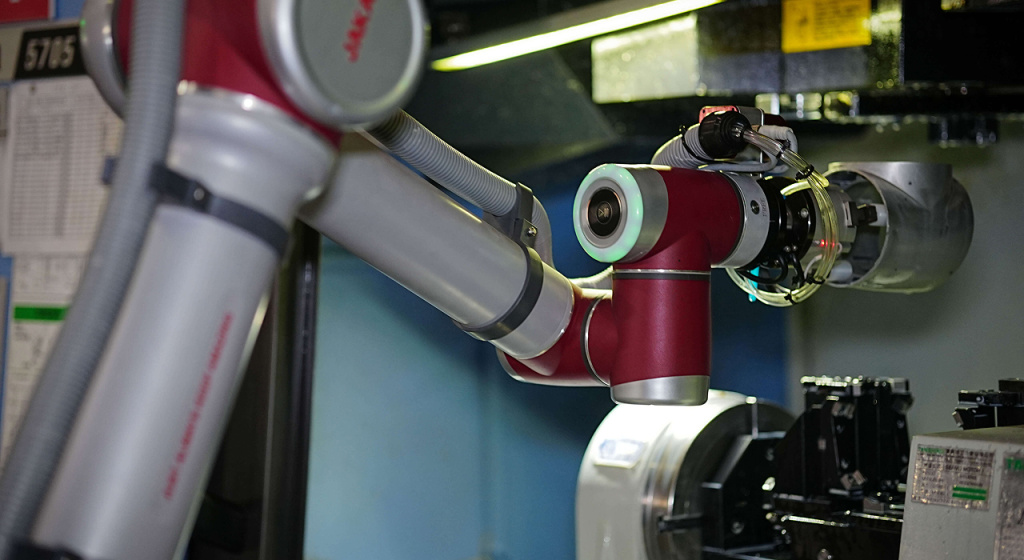
Task: The cobot feeds items into a machine or station and removes finished ones.
Requirements:
- Raise efficiency and quality.
- Redeploy the line quickly for flexible machine tending.
- Use simple programming to replace manual labor.
Solution: JAKA Zu7 (7 kg payload, 819 mm reach), JAKA Zu12 (12 kg, 1,327 mm), JAKA Zu18 (18 kg, 1,073 mm), JAKA Zu20 (20 kg, 1,780 mm), JAKA Zu30 (30 kg, 1,350 mm) and JAKA MiniCobo (1 kg, 580 mm) for very light items. Browse the full JAKA Zu series.
Can a Cobot Pack Medicine Boxes and Cartons?
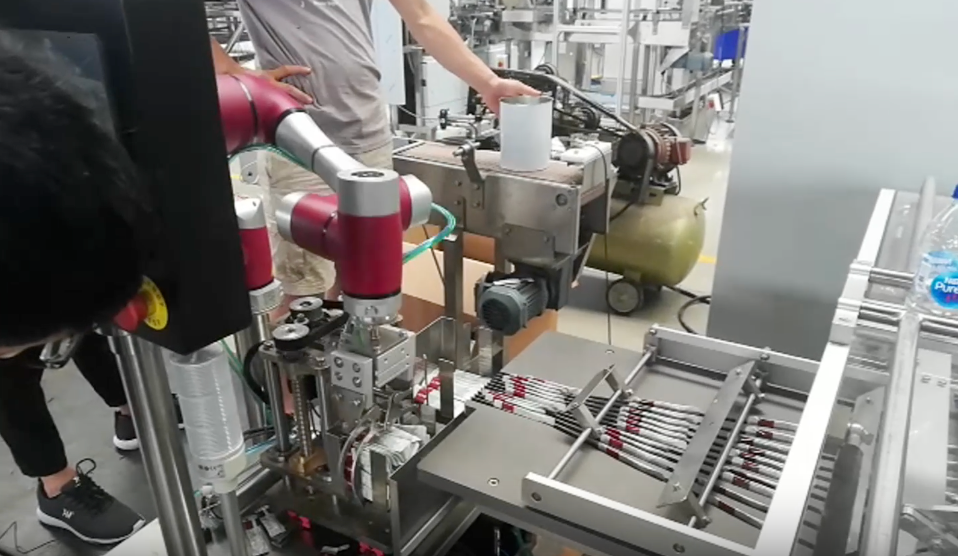
Task: Packing means placing boxes or items into cartons and cases. The cobot takes over this repeated step beside the line.
Requirements:
- Replace manual labor, lower management costs and raise the production rate.
- Repeat each move precisely, to protect quality and reduce reworked and scrapped parts.
Solution: JAKA Zu7, JAKA Zu12, JAKA Zu18, JAKA Zu20 and JAKA Zu30, all listed for packing. Pair them with DH-Robotics electric grippers chosen for the box or item. Guard the cell with SDKELI safety lidar where the risk assessment calls for it.
Can a Cobot Sort Tubes, Vials and Small Items?
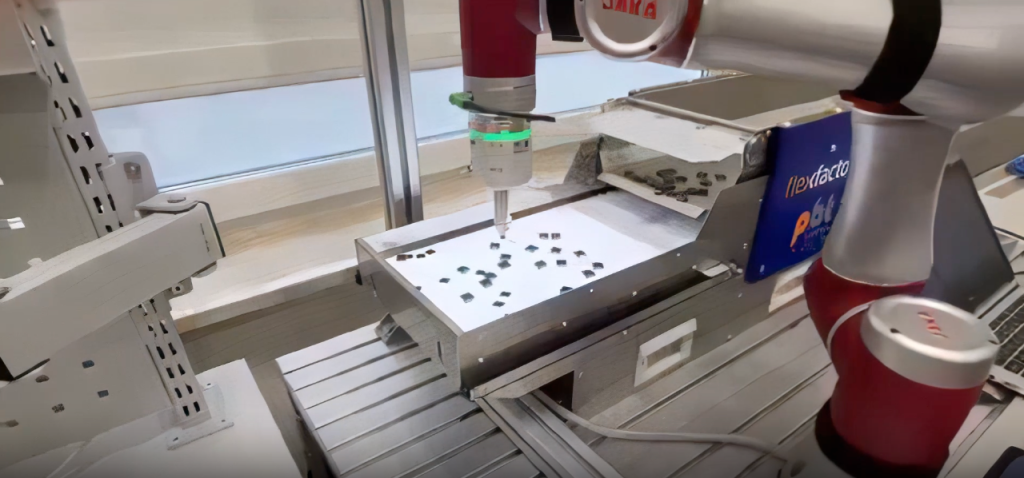
Task: The cobot sorts items by type or by result, for example after a camera has classified a test tube.
Requirements:
- Reprogram quickly for different items.
- Keep precision consistent and lower the defect rate.
- Replace manual operators in repetitive sorting.
Solution: JAKA Mini 2 (2 kg, 580 mm) and JAKA MiniCobo. Browse the JAKA Mini series.
Which JAKA Cobot Fits Which Pharmaceutical Task?
|
Task |
JAKA models |
|---|---|
| Loading and unloading | Zu7, Zu12, Zu18, Zu20, Zu30, MiniCobo |
| Packing | Zu7, Zu12, Zu18, Zu20, Zu30 |
| Sorting | Mini 2, MiniCobo |
How Do You Start a Pharmaceutical Automation Project?
Start with one station and one measurable problem, then expand.
- Define the failure to prevent. Examples are an uncut capsule, an unreadable code, a wrong category or manual handling.
- Pick the task type. Inspecting, reading and measuring point to Hikrobot. Feeding, packing and sorting point to a JAKA cobot.
- Check the physical limits. For vision, note item size, finish, speed and field of view. For a cobot, note item weight, reach and tooling.
- Test on real products. Run good and bad samples under production lighting.
- Check the rules and the data. Confirm hygiene and quality requirements with your quality team, and plan PLC communication and where results are stored. To size the payoff, read how to calculate machine vision ROI.
The same method works in other sectors, as in our consumer products and food and beverage guides. Share your product, line speed and goal when you ask ELVOTEC for a recommendation.