
Automotive
Automotive Automation Solutions
Short answer: Automotive automation uses machine vision, robots and cobots to inspect, identify, assemble and move parts with less variation and less manual work. Hikrobot smart cameras, area scan cameras and code readers handle error-proofing, defect inspection and traceability. JAKA cobots handle loading, screwdriving, assembly, grasping, gluing and handling.
Why Does Automation in the Automotive Industry Matter?
A vehicle is built from a large number of parts, and many of them are safety-relevant. One missing screw, one scratched gear or one unreadable code can mean rework, scrap or a quality escape.
Robots are already central to automation in the automotive industry. The International Federation of Robotics reported that car and component makers accounted for 33% of U.S. industrial robot installations in 2023, with a record 14,678 robots installed. Smaller suppliers can now follow, because cameras and cobots are easier to deploy than traditional cells.
Automation in the automobile industry also makes a practical case: stable quality, traceable parts and less repetitive manual work. Vision protects quality at the station, while a cobot takes over the tasks people should not repeat all day.
Which Brands Can You Use for Automation in the Auto Industry?
ELVOTEC integrates several brands that cover the main tasks:
- Hikrobot: machine vision for inspection, measurement, guidance and code reading.
- JAKA: collaborative robots for repetitive handling and assembly work.
- DH-Robotics: electric grippers for the robot end.
- SDKELI and Akusense: safety lidar and light curtains for guarding the cell.
New to the technology? Start with what machine vision is.
Machine Vision Applications in Automotive Automation
Machine Vision for Automotive means cameras and software that check parts on the line and decide pass or fail automatically. The three cases below follow Hikrobot's own automotive case studies and application documents. For the broader quality picture, see how machine vision improves quality control.
How Does a Smart Camera Error-Proof Automotive Assemblies?
Task: The camera confirms that every screw, washer, gasket, seal or spring is present and correctly oriented before the part moves on. Hikrobot's cases include a door handle (screw holes, rubber ring, edge seal and a 2D code), a control arm with gaskets checked by three cameras, and an engine part with more than 50 springs.
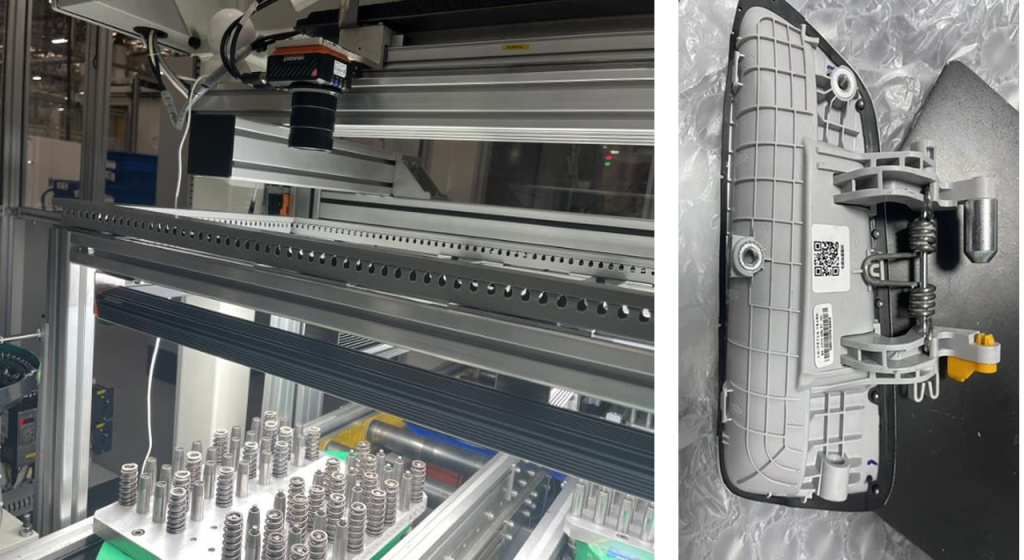
Requirements:
- Detect missing, wrong or misoriented screws, washers, gaskets and springs.
- Capture large products in one shot despite screw depth, deformation and reflections.
- Switch between product variants without manual changes to the inspection scheme.
- Send results to a PLC and reject faulty parts.
Hikrobot reports detection accuracy above 99.99% in its door handle case.
Solution:
- MV-SC3030XC-12M-WBN: door handle checks plus 2D code reading.
- MV-SC3050XC-12M-WBN: screw presence on large workpieces, using AI registration classification.
- MV-SC6050M-00C: engine assemblies with 50+ springs, wide field of view.
- MV-SC3000: gasket presence and posture.
- MV-SC2004PM: presence and orientation of small metal parts, plus angle checks within ±2°.
All of these belong to the smart camera range. If you are unsure whether you need one, read what a smart camera is.
How Does Machine Vision Inspect Surfaces, Glue and Dimensions?
Task: An area scan camera and VisionMaster software image machined parts and shells, then find defects, check glue paths and measure features. Hikrobot's cases cover gearbox parts, a shell glue path, running-line surface checks and wheel hub classification.
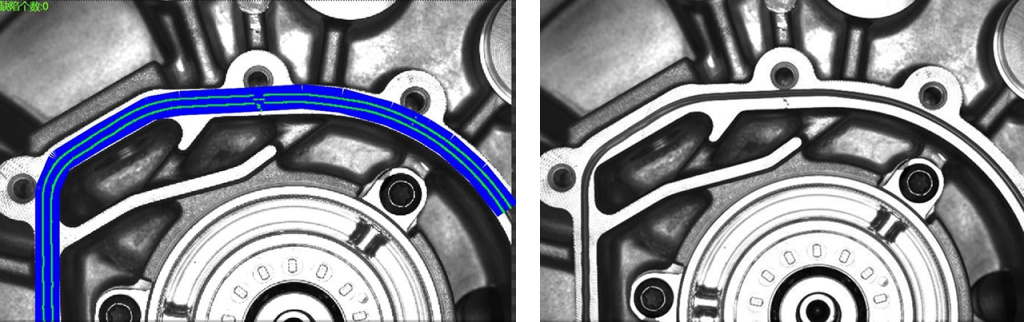
Requirements:
- Find scratches, dents, burrs and missing holes on a running line.
- Measure inner and outer diameter, height and width to 60 microns with 360° coverage (gearbox part).
- Verify a glue path on a large shell at high speed. Dirt affects the edges, so exposure differs by section.
- Identify wheel hub types in a short cycle time and add new types without long retraining.
For the shell, Hikrobot moved a 20-megapixel camera with a servo and took five shots. For the wheel hub, GPU processing time stayed within 20 ms.
Solution:
- MV-CE060-11GM: gearbox part inspection and measurement.
- MV-CE100-20GM: surface defects and hole checks on a running line.
- MV-CS200-10GM: large shells and glue paths, with the MVL-KF1628M-12MP lens and MV-LBES2-300-300-Y50-B light.
- MV-CA050-10GM: deep-learning wheel hub classification.
These are area scan cameras. Pair them with the right light source, and use a vision controller when several cameras share one station.
How Does Machine Vision Read Direct Part Marks for Traceability?
Task: An ID code reader decodes Data Matrix codes marked directly on gears, battery boxes, control units and tires, so every part links to its production record.
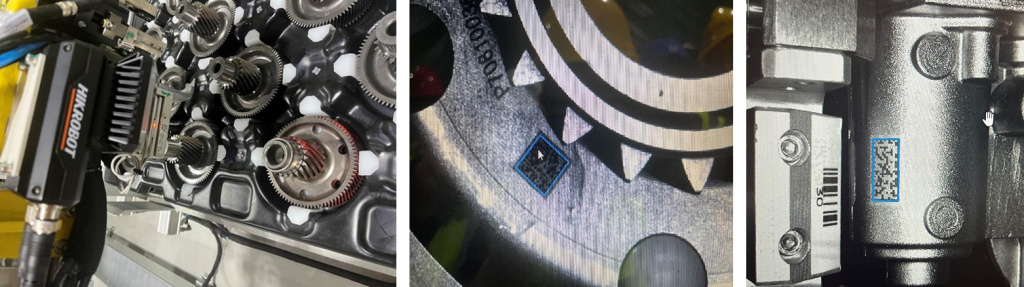
Requirements:
- Read low-contrast codes on battery boxes without stopping the line.
- Read a 4×4 mm code on a rotating gear through an oil film and reflections.
- Reach a 100% read rate on a laser-marked control unit code in a tight space with metallic reflection.
- Read small tire sidewall codes from a long distance.
- Read stator and rotor codes by hand where fixed mounting is not practical.
Solution:
- MV-ID5060PM: oil-covered gear codes.
- MV-ID3030XM-08M-RBN: small codes on rotating gears.
- MV-ID3016PM: low-contrast battery box codes.
- MV-ID5120M: laser-marked control unit codes. A polarizer overcame the reflections in Hikrobot's case.
- MV-ID5200M-00C-NNN: tire codes with a large field of view.
- MV-IDH7010 series: handheld reading of stator and rotor codes.
JAKA Cobots for Automotive Automation
Automotive robotics no longer means only large caged robots. Cobots work beside people, move between stations and are reprogrammed for new parts. If the term is new, read what a collaborative robot is.
JAKA lists six automotive scenarios. The models below come from the typical applications on each JAKA product page. Final choice depends on payload, reach and tooling, and this comparison of JAKA cobot series can help.
Can a Cobot Handle Loading and Unloading?
Task: The cobot feeds parts into a machine and removes finished ones.
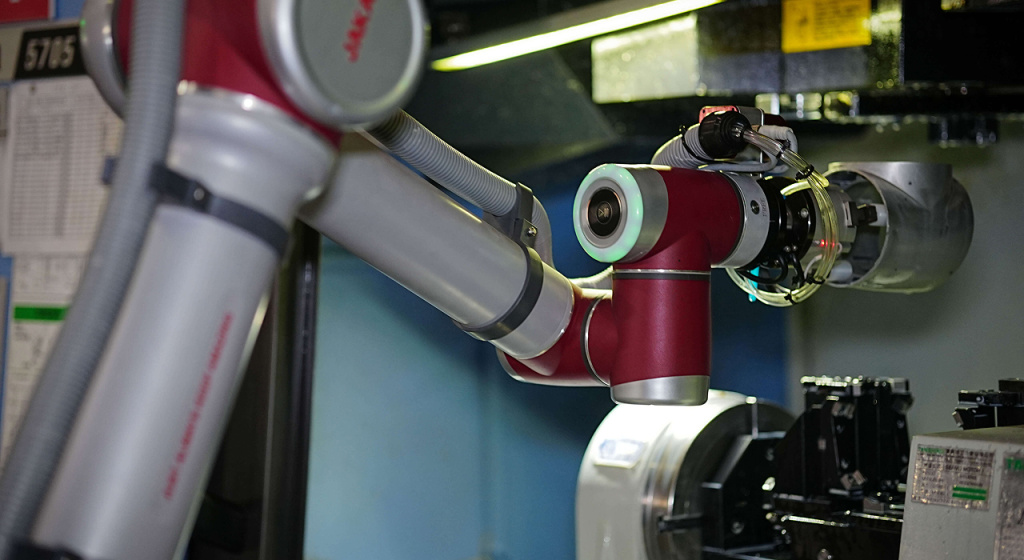
Requirements:
- Redeploy the line quickly.
- Run flexible, high-quality machine tending.
- Use simple programming so operators can adjust it.
Solution: JAKA Zu Series - JAKA Zu7 (7 kg payload, 819 mm reach), JAKA Zu12 (12 kg, 1,327 mm), JAKA Zu18 (18 kg, 1,073 mm) and JAKA Zu20 (20 kg, 1,780 mm).
Can a Cobot Do Screwdriving?
Task: The cobot drives screws at a fixed torque on each part.
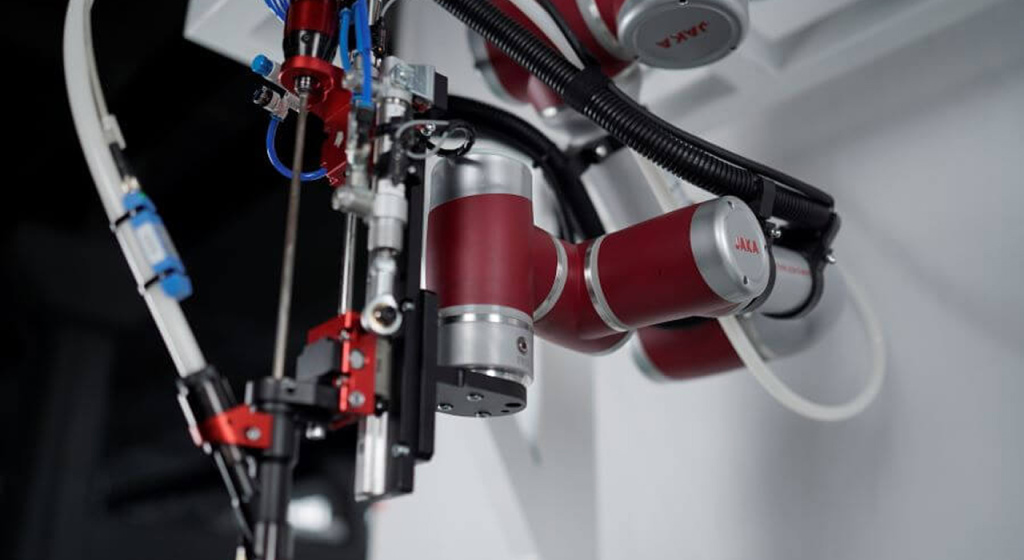
Requirements:
- Set the torque range to match the screw.
- Respond quickly and run stably.
- Keep quality consistent from part to part.
Solution: JAKA Zu Series - JAKA Zu3 (3 kg, 626 mm), JAKA Zu5 (5 kg, 954 mm) and JAKA Zu7.
A camera helps when screw positions vary. In one Hikrobot screw-locking case with a different robot, the target accuracy was 1 mm and the project went into initial use in less than three days.
Can a Cobot Perform Flexible Assembly?
Task: The cobot places and fits components on mixed products.
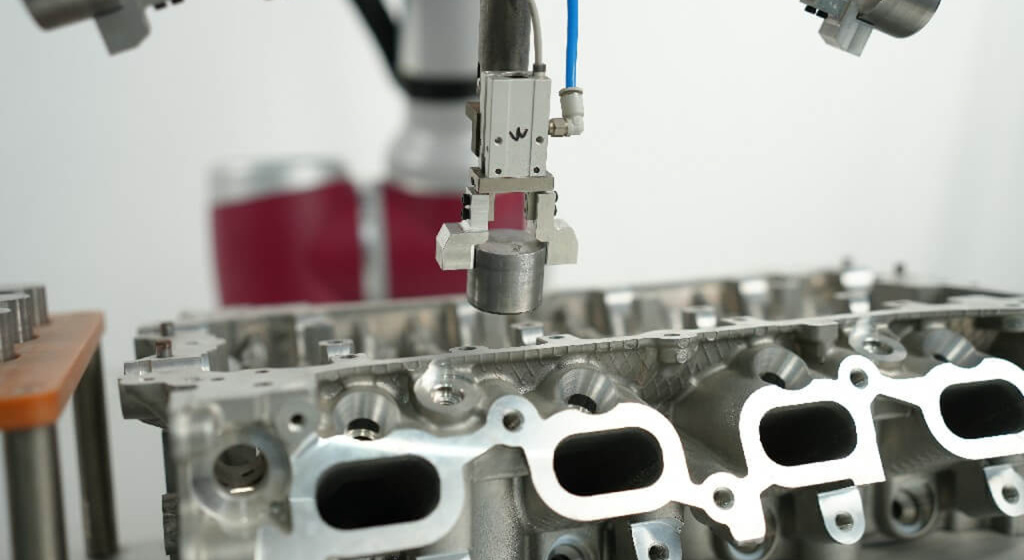
Requirements:
- Assemble with high precision and adapt to the part.
- Avoid dropping or losing workpieces.
- Support small batches and many variants.
Solution: JAKA Zu Series - JAKA Zu5 and JAKA Zu7.
Can a Cobot Do Flexible Grasping?
Task: The cobot picks parts of different shapes and sizes.
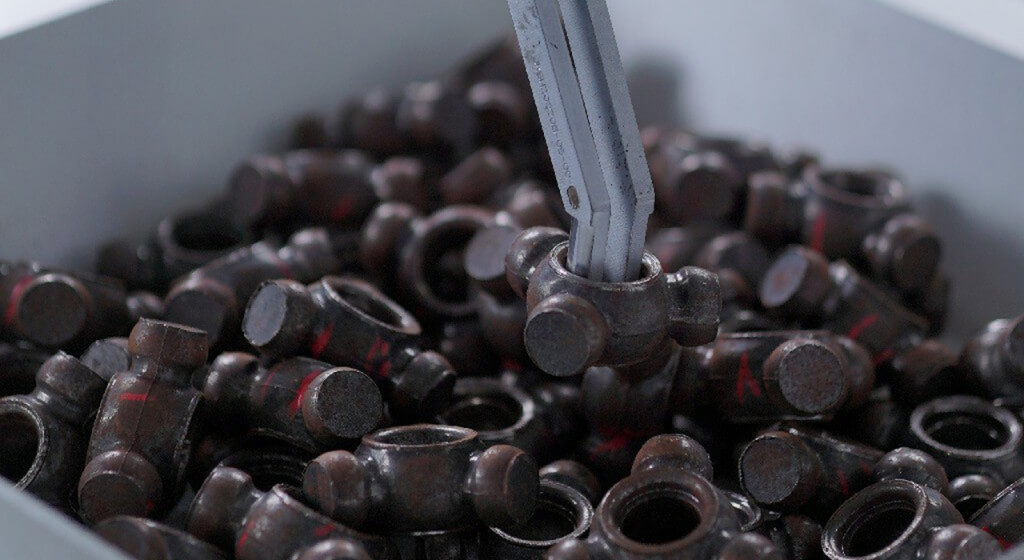
Requirements:
- Grasp accurately without losing the workpiece.
- Change over quickly between part types.
- Fit into a small cell.
Solution: JAKA Zu Series -JAKA Zu3 and JAKA Zu5, paired with DH-Robotics electric grippers chosen for the part.
Can a Cobot Apply Glue?
Task: The cobot dispenses glue along a defined path.
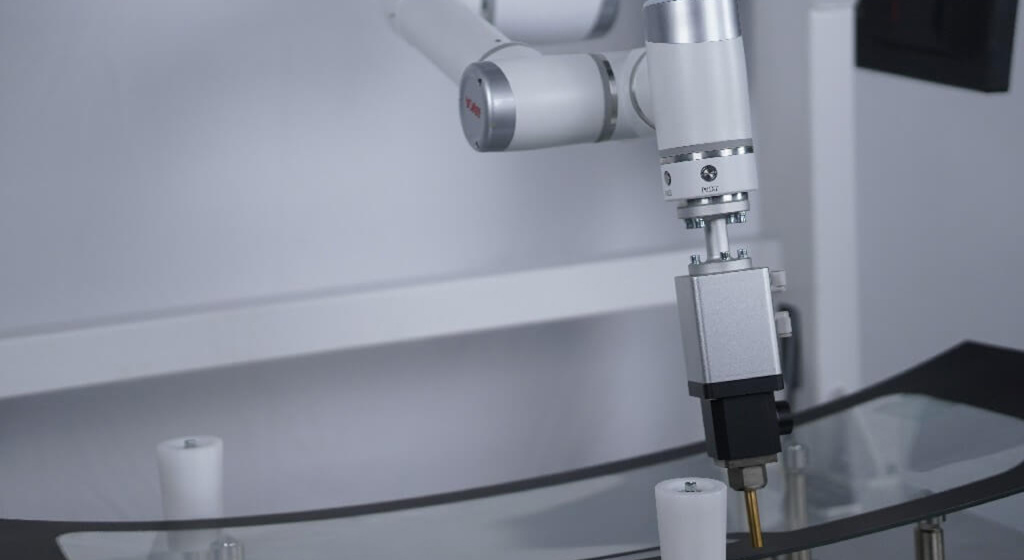
Requirements:
- Replace manual dispensing.
- Control flow accurately and save glue.
- Improve the look of the bead and reduce labor.
Solution: JAKA Zu3 and JAKA Zu5. JAKA also lists adhesive application for the Zu18, which suits heavier tooling.
Can a Cobot Handle Parts Near Hazardous Equipment?
Task: The cobot moves workpieces between stations and processing equipment.
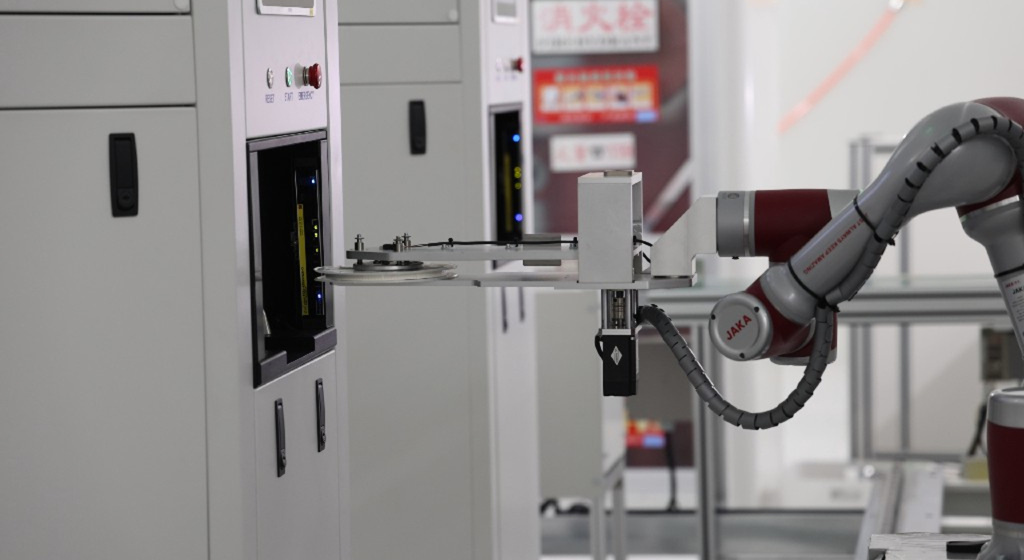
Requirements:
- Keep processing precision consistent and lower the defect rate.
- Reprogram quickly for different workpieces.
- Replace operators near hazardous equipment.
Solution: JAKA Zu5, JAKA Zu12, JAKA Zu18, and the compact JAKA Mini 2 (2 kg, 580 mm) for small parts. Browse the JAKA Zu series and the JAKA Mini series. Guard the cell with SDKELI safety lidar where the risk assessment calls for it.
How Do You Start an Automotive Automation Project?
Start with one station and one measurable problem, then expand.
- Define the failure you want to prevent. Examples are a missing screw, a surface defect, an unreadable code or an operator injury risk.
- Pick the task type. Inspection and identification point to Hikrobot. Repetitive handling, screwdriving or gluing points to a JAKA cobot.
- Check the physical limits. For vision, note part size, finish, speed and available mounting space. For a cobot, note part weight, reach and tooling.
- Test on real parts. Run good and bad samples under production lighting before you finalize the design.
- Add safety and data. Plan guarding, PLC communication and where results are stored.
ELVOTEC can help match products to your station, so share your part, cycle time and goal when you ask for a recommendation.