
News
JAKA Cobot Series Compared: Zu, Pro, S, A, AL and Mini
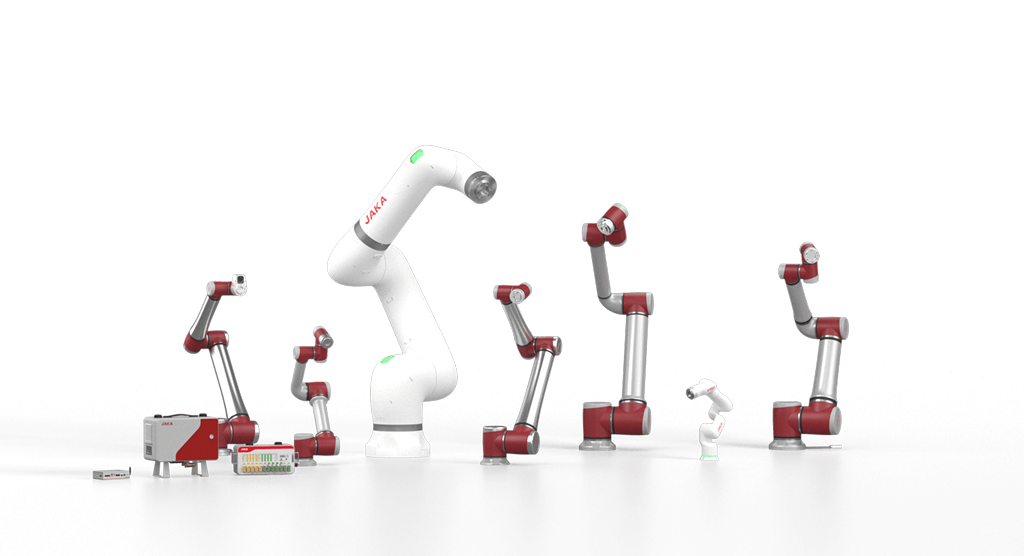
Short answer: JAKA offers six collaborative robot series within its cobot lineup, each built around a different priority. The Zu Series is the general-purpose flagship with the widest range of models. The Pro Series is built for continuous duty in harsh, IP68-rated environments. The S Series adds an integrated force/torque sensor for contact-sensitive work like polishing and assembly. The A Series is the standard mid-range line. The AL Series trades payload for lighter weight and speed. The Mini Series is built for the smallest workspaces. The right one depends on payload, reach, and how the robot will actually be used — not which series name sounds most advanced.
What Do Payload, Reach, and Repeatability Mean?
Before comparing series, it helps to define the three specs that distinguish them. Payload is the maximum weight the robot can carry at its wrist, including any gripper or tool. Reach is the maximum horizontal distance the arm can extend from its base. Repeatability is how precisely the robot returns to the same point on repeated cycles, expressed in millimeters — a smaller number means tighter precision. These three figures, more than the series name itself, determine whether a given JAKA cobot fits a specific task.
JAKA Zu Series: The General-Purpose Flagship
The Zu Series is JAKA's broadest cobot lineup, spanning seven models from the Zu3 up to the Zu30. Payload ranges from 3 kg to 30 kg, and reach spans from 626 mm to 1780 mm, so the series covers everything from light pick-and-place to heavy palletizing within one product family. Repeatability tightens from ±0.02 mm on the lighter models to ±0.05 mm on the higher-payload versions — a normal trade-off as payload and reach increase.
Benefits:
- Widest payload and reach range in JAKA's lineup, from light-duty to heavy-duty in one family
- No specialized enclosure rating or force sensor required, keeping cost and complexity lower
- Simple to redeploy across different tasks as production needs change
Application industries: Automotive, electronics, food & beverage, logistics, home appliance production, and general industrial manufacturing.
Tasks:
- Machine tending and loading/unloading
- Pick-and-place and packaging
- Assembly and quality inspection
- Palletizing
Because it spans such a wide range, JAKA Zu Series robots are the default starting point whenever a task doesn't clearly call for the Pro Series' IP68 rating or the S Series' force control.
JAKA Pro Series: Built for Continuous, Harsh-Environment Duty
The Pro Series is built for production environments that would damage a standard cobot: dust, metal shavings, and liquids including water and oil. Its IP68 rating — the highest in JAKA's lineup — lets it run non-stop in conditions the Zu and A series aren't rated for.
Across its three models (Pro5, Pro12, Pro16), payload ranges from 5 kg to 16 kg and reach from 954 mm to 1713 mm, with repeatability of ±0.02 mm to ±0.03 mm.
Benefits:
- IP68 ingress protection, the highest rating in JAKA's cobot lineup
- Built for 24/7 operation without extra enclosures against dust or liquids
- Handles harsh byproducts of production — coolant, metal shavings, moisture — without downtime
Application industries: Automotive, metal manufacturing, electronics, food & beverage, logistics, and consumer goods production.
Tasks:
- Continuous machine tending and loading/unloading
- Welding
- Packaging, palletizing, and sorting
- Heavy-duty material handling and end-of-line automation
The JAKA Pro Series is the natural choice whenever dust, coolant, or liquids are a normal part of daily operation, particularly in automotive and metal-processing plants.
JAKA S Series: Precision Through Integrated Force Sensing
The S Series is built around one defining feature: an integrated force/torque sensor at the robot's base or end effector. This lets the robot actively control contact force rather than just position, supporting operating modes such as constant force, surface tracking, and speed-based control.
The two current models, S5 and S12, cover 5 kg to 12 kg payload and 954 mm to 1327 mm reach, with an IP65 rating.
Benefits:
- Active force control instead of position-only movement
- Multiple control modes: constant force, surface tracking, and speed-based operation
- More consistent output quality on contact-sensitive work than a standard cobot arm
Application industries: Electronics, automotive, home appliance manufacturing, metal processing, and advanced manufacturing.
Tasks:
- Screwdriving and precision assembly
- Gluing, polishing, and grinding
- Welding and labeling
This force-sensing capability makes the JAKA S Series the right choice whenever consistent contact pressure matters more than raw speed.
JAKA A Series: The Standard Mid-Range Choice
The A Series covers the same practical territory as the Zu Series — general-purpose machine tending, assembly, and material handling — across three models: A5, A12, and A20. The A12, for example, handles a 12 kg payload with a 1327 mm reach, in the same range as the equivalent Zu and Pro models. Its end joint carries an IP67 rating, giving it more environmental resistance than the base Zu Series without the full IP68 protection of the Pro line.
Benefits:
- IP67-rated end joint for added durability over the standard Zu Series
- Straightforward, general-purpose operation without extra certification cost
- Practical middle ground between the Zu and Pro series
Application industries: Automotive manufacturing, electronics production, and metalworking.
Tasks:
- Machine loading and unloading
- Screwdriving
- Material handling and welding
- Palletizing
For manufacturers who want a general-purpose cobot without the Pro Series' harsh-environment certification, the JAKA A Series is a practical option for standard, controlled production environments.
JAKA AL Series: Lightweight and Fast for Precision Tasks
The AL Series is built around a different trade-off: less emphasis on maximum payload in exchange for a lighter arm, faster motion, and enhanced perception for precision work. Rather than competing on lifting capacity, it targets tasks where speed and positioning accuracy matter more than handling heavy parts — small-part assembly, packaging, dispensing, and lab automation.
Benefits:
- Lighter arm construction for faster cycle times
- Enhanced perception for more accurate part handling
- Compact enough for workstations a bulkier arm couldn't fit into
Application industries: Electronics, medical device manufacturing, laboratories, consumer goods, food & beverage, and logistics.
Tasks:
- Pick-and-place and flexible assembly
- Machine tending and quality inspection
- Packaging, screwdriving, and adhesive dispensing
- Laboratory automation
Because of its lighter construction, the JAKA AL Series suits compact workstations where a bulkier arm would be harder to fit and maneuver.
JAKA Mini Series: Built for the Smallest Workspaces
The Mini Series is JAKA's smallest and lightest cobot line, built specifically for compact workspaces rather than heavy-duty tasks. The MiniCobo model handles a 1 kg payload with a 580 mm reach and ±0.1 mm repeatability, while the Mini2 steps up to a 2 kg payload at the same 580 mm reach with a tighter ±0.05 mm repeatability.
Benefits:
- Smallest footprint in JAKA's entire cobot lineup
- Fast installation and simple programming
- Fits workstations where a full-size cobot physically wouldn't
Application industries: Electronics manufacturing, medical device production, laboratories, pharmaceuticals, and precision engineering.
Tasks:
- Precision assembly and pick-and-place
- Quality inspection and testing
- Screwdriving and dispensing
- Small-part handling
The JAKA Mini Series is the right call whenever installation space, not payload, is the limiting factor.
JAKA Cobot Series Compared: Side-by-Side
With six series covering overlapping payload ranges, the fastest way to compare them is side by side. The table below summarizes each series' practical range and defining feature.
| Series | Payload Range | Reach | Defining Feature | Best For |
|---|---|---|---|---|
| Zu | 3–30 kg | 626–1780 mm | Widest model range in the lineup | General-purpose tasks |
| Pro | 5–16 kg | 954–1713 mm | IP68, harsh-environment rated | Continuous duty, welding |
| S | 5–12 kg | 954–1327 mm | Integrated force/torque sensor | Contact-sensitive work |
| A | 5–20 kg | up to 1327 mm (A12) | IP67-rated end joint | Standard mid-range use |
| AL | Lighter-duty | Compact | Lightweight, fast motion | Precision, small parts |
| Mini | 1–2 kg | 580 mm | Smallest footprint in the lineup | Lab and electronics work |
Which JAKA Series Should You Choose?
Start with the environment, not the payload number. If the cobot will run in a clean, general-purpose setting, the Zu or A Series covers most tasks. If dust, coolant, or liquids are part of daily operation, the Pro Series' IP68 rating is the safer choice. If the task depends on controlled contact force — polishing, gluing, precision assembly — the S Series is built specifically for that. Tight workspaces favor the AL or Mini Series depending on how much payload is still needed.
As an official JAKA distributor, Elvotec matches the right series and model to your specific application — building on the fundamentals covered in our cobot guide.
Frequently Asked Questions
Which JAKA series has the highest payload?
The Zu Series goes highest, up to 30 kg on the Zu30 — the largest payload in JAKA's standard lineup, intended for heavy palletizing and large-part handling.
What's the difference between the JAKA A Series and the Zu Series?
Both cover similar general-purpose tasks and overlapping payload ranges, but the A Series carries an IP67-rated end joint for extra environmental resistance, while the Zu Series offers a wider spread of models from 3 kg up to 30 kg.
Which JAKA series is best for welding?
The Pro Series is the usual choice, since its IP68 rating handles the dust, spatter, and heat associated with welding environments better than the standard Zu or A series.
Is the JAKA S Series only useful for force-sensitive tasks?
It can still handle general pick-and-place and assembly work, but its integrated force/torque sensor is specifically what makes it the better option for tasks like polishing, gluing, and precision fitting where contact pressure needs active control.
Can I mix JAKA series on the same production line?
Yes. Many production lines use a Zu or A Series robot for general handling, a Pro Series robot at a harsh-environment station, and a Mini or AL Series robot for compact, precision tasks elsewhere on the same line.