
News
What Is a Collaborative Robot (Cobot)? Cobots vs. Industrial Robots
Short answer: A collaborative robot, or cobot, is a robotic arm designed to work directly next to a person in a shared workspace, using built-in sensors instead of a safety cage to stay safe. A traditional industrial robot, by contrast, is built for maximum speed and payload inside an isolated, guarded cell that no one enters during operation. In short: an industrial robot replaces manual work behind a fence; a cobot assists manual work right next to a person.
What Is a Collaborative Robot (Cobot)?
A cobot — short for "collaborative robot" — is an industrial robotic arm built for direct human-robot collaboration: operating in the same space, at the same time, as a person, without the physical barriers that surround conventional automation. The concept dates back to 1996, when Northwestern University professors J. Edward Colgate and Michael Peshkin built the first collaborative robot prototypes, and colleague Brent Gillespie coined the word itself, as documented in the history of the cobot on Wikipedia. Today, "cobot" and "collaborative robotic arm" are used interchangeably.
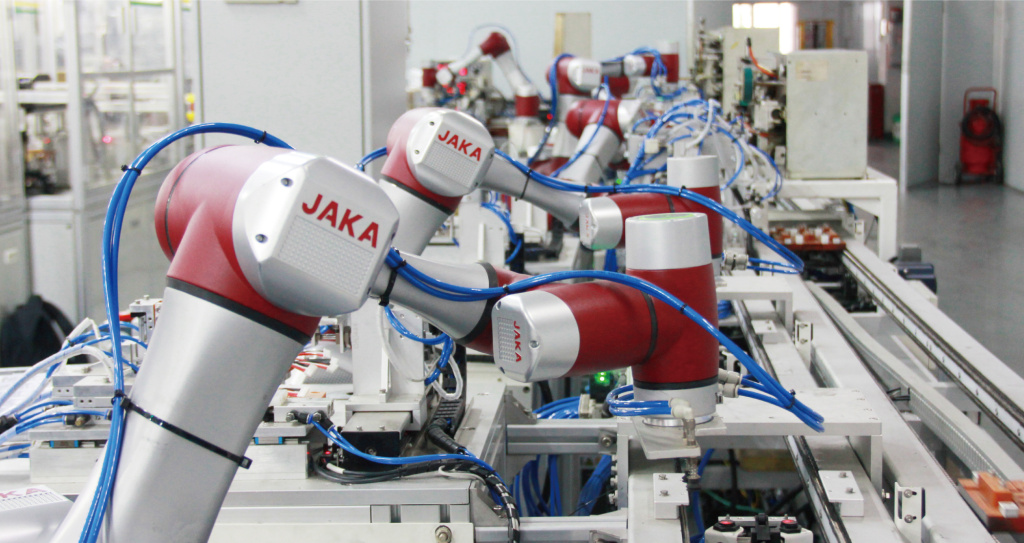
What actually separates a cobot from older industrial equipment isn't one single feature — it's a design philosophy. Rounded joints replace sharp pinch points, force- and torque-sensing replace unmonitored motion, and onboard software can slow or stop the arm the instant it meets unexpected resistance. That combination is what lets a cobot share a workbench with a person rather than being fenced away from one, and it's the reference point for every comparison with a traditional industrial robot.
How Does a Cobot Differ from an Industrial Robot?
The core difference comes down to where and how each robot is meant to operate. An industrial robot is optimized for raw performance — speed, payload, repeatability — inside a dedicated, guarded work cell that no person enters while it's running. A cobot trades some of that raw performance for the ability to work safely beside a person, often without a perimeter fence at all. The table below breaks down the practical differences.
Cobot vs. Industrial Robot: Key Differences at a Glance
| Factor | Industrial Robot | Cobot |
|---|---|---|
| Operating environment | Enclosed, guarded work cell | Shared workspace with human operators |
| Design priority | Speed, payload, cycle time | Safety, flexibility, easy redeployment |
| Payload and speed | Generally higher and faster | Generally lower, by design |
| Programming | Specialized robot programming | Often taught by hand-guiding |
| Safety approach | Perimeter guarding, light curtains, interlocks | Force/torque limiting, risk-based collaboration |
| Best fit | High-volume, unchanging production | Small/mid-batch, frequently changing tasks |
These categories describe design intent, not a fixed hardware boundary. Some cobots run behind guarding when a task's speed or tooling calls for it, and some industrial robots can be fitted with safety-rated monitoring to work collaboratively. What decides the label is how the whole application — robot, tool, and task — is risk-assessed, not the arm on its own.
Do Cobots Need Safety Cages?
Not in most applications — that's largely the point of choosing a cobot. But "no cage" doesn't mean "no safety process." Whether a specific installation needs a physical barrier depends on a risk assessment of the task: payload, end-of-arm tooling, speed, and how likely contact with a person actually is.
This is where formal robot safety systems come in. Industrial robots are governed by ISO 10218, and collaborative applications add the requirements of ISO/TS 15066, which defines four recognized modes of safe human-robot operation: safety-rated monitored stop, hand guiding, speed and separation monitoring, and power and force limiting. A cobot's built-in force sensors typically support the last of these, slowing or stopping the arm the moment it senses unexpected resistance — well before contact could cause harm.
For manufacturers, a cobot is a strong starting point for a safer cell, not an automatic guarantee. ELVOTEC also works with industrial safety systems — light curtains, safety relays, and lidar-based scanners — for applications where a cobot alone doesn't fully cover the risk, or where a mixed line combines cobots with faster, unguarded equipment nearby.
What Are Cobots Used For? (Collaborative Robot Applications)
Cobots suit tasks that are repetitive and physically demanding, but still benefit from a person working close by. Common collaborative robot applications include:
- Machine tending — loading and unloading CNC machines, presses, or injection molding equipment
- Pick-and-place and packaging — moving parts between stations or into cartons at a steady pace
- Small-part assembly — screwdriving and light fastening on electronics or components
- Palletizing — stacking finished goods without the fatigue of repetitive manual lifting
- Quality inspection support — holding or presenting parts for a camera, often paired with a machine vision system for defect detection or code reading
Adoption is strongest in electronics, automotive, food and beverage, pharmaceutical, and consumer goods manufacturing — industries where product lines change often and floor space is limited. ELVOTEC supplies the JAKA cobots range for exactly these settings, from lightweight general-purpose arms like the JAKA Zu series up to heavier-duty models built for more demanding handling work.
How Much Do Cobots Cost Compared to Industrial Robots?
Cobots typically cost less to deploy than industrial robots once the whole project — not just the arm — is priced out. The robot itself isn't always the cheaper line item; the savings usually come from everything built around it.
A traditional industrial robot cell often needs perimeter fencing, interlocked doors, light curtains, dedicated floor space, and a specialized integrator to program and commission it — all added on top of the robot's own price. A cobot, by design, frequently needs less of that surrounding infrastructure, subject to its own risk assessment, and many models can be taught through hand-guiding rather than requiring dedicated robot-programming expertise. Because a cobot can often be redeployed from one task to another, the same arm can help offset the cost of automating several jobs instead of just one.
That said, "cheaper" isn't universal. For a single high-volume process running at maximum speed, a dedicated industrial robot can still produce a lower cost per unit over time, simply because it moves faster. The right comparison is total cost of ownership for the specific task at hand — not the sticker price of the arm alone.
Cobot or Industrial Robot: Which One Fits Your Line?
Choose a cobot when tasks change often, floor space is tight, or the same arm needs to move between several jobs without a full cell rebuild. Choose an industrial robot when a single high-volume process needs maximum speed and payload, and the job justifies a dedicated, guarded cell built around it.
Many manufacturers don't have to choose only one. Mixed lines that pair cobots for flexible tasks with industrial robots for high-speed ones are increasingly common as part of a broader manufacturing automation strategy. ELVOTEC provides industrial automation solutions across machine vision, cobots, and safety systems, and its consultation and design service can help match a specific task — payload, cycle time, and layout — to the right type of robot before any equipment is ordered.
Frequently Asked Questions
Is a cobot a type of industrial robot?
Technically, yes. A cobot is a category of industrial robot; the term simply describes machines built to work directly alongside people, not a separate class of hardware.
Can a cobot replace an industrial robot on a high-speed line?
Usually not on its own. Cobots are built for flexibility and safety rather than maximum throughput, so a single, very high-volume process is typically still better served by a dedicated industrial robot.
Do cobots always work without safety cages?
No. Whether a barrier is needed depends on a risk assessment of the task, tooling, and speed — not simply on the fact that the robot is called a cobot.
How much payload can a cobot handle?
It varies by model. Lighter cobots are built for small-parts handling, while heavier-duty versions are designed for palletizing and machine tending — check the specifications of the individual series for exact figures.
Are cobots harder to program than industrial robots?
Generally, no. Many cobots can be taught by hand-guiding the arm through a task, which is typically simpler than the specialized programming an industrial robot cell requires.