
News
3D Machine Vision Camera Types Explained: Line Laser, Stereo and RGB-D Compared
Short answer: The three main 3D machine vision camera types are line laser (laser triangulation) cameras, stereo vision cameras, and RGB-D cameras. Each calculates depth a different way — a laser line's deflection, the disparity between two camera views, or a depth sensor paired with color — which makes each one suited to a different task: line laser for high-precision profiling on a moving line, stereo for fast, wide-field depth using only ambient light, and RGB-D for combining color and depth in robot guidance and bin-picking.
How Does a 3D Camera Work in Machine Vision?
Unlike a standard 2D camera, which captures a flat image, a 3D camera measures the distance to each point in a scene and outputs a point cloud — a set of 3D coordinates describing an object's actual shape, not just its appearance. Different camera types calculate that distance in different ways: by triangulating a projected laser line, by comparing two simultaneous camera views, or by timing how long light takes to travel to the object and back.
That difference in method is what drives the trade-offs between camera types. A method that needs a moving part (like line laser scanning) suits a conveyor line; a method that needs two camera views (stereo) suits a large, well-lit scene; and a method that adds color to depth (RGB-D) suits picking and sorting tasks where telling objects apart matters as much as measuring them.
What Is Line Laser 3D Scanning (Laser Triangulation)?
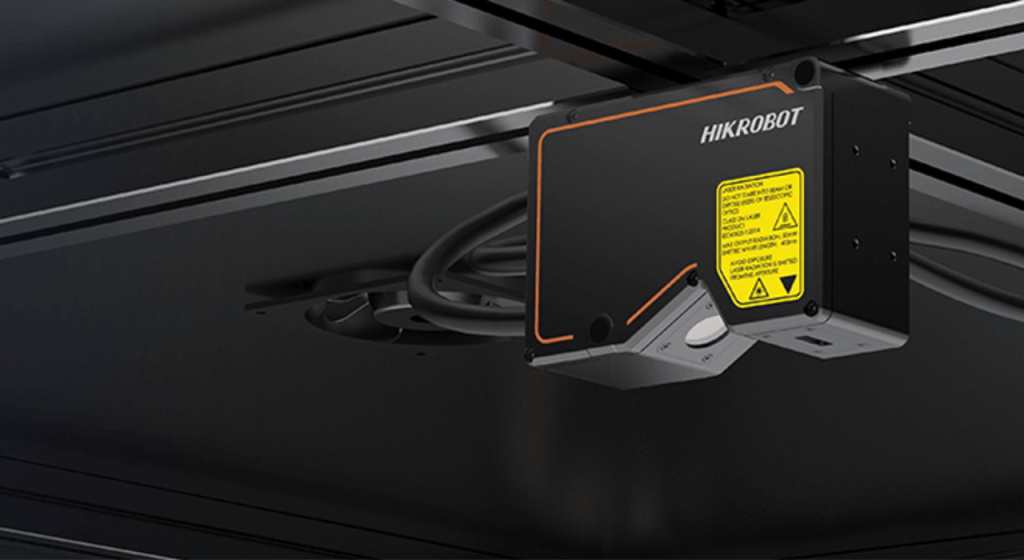
A line laser 3D camera projects a thin laser line onto a moving object, and a camera positioned at a fixed angle captures how that line bends and shifts as it crosses the object's surface. As the part moves past the laser, hundreds of these individual profiles are stitched together into a complete 3D image — this method is known as laser triangulation.
Line laser scanning is simple, relatively low-cost, fast, and highly accurate, which is why it's the standard choice for conveyor-based inspection where parts already move past a fixed point. It doesn't capture color information, and it needs consistent relative motion between the camera and the part to build a usable scan — on a static object with no motion, it isn't the right tool. The Hikrobot Line Laser 3D Camera is built specifically for this kind of in-line profiling.
What Is a Stereo Vision Camera, and How Does It Work in Industrial Settings?
A stereo vision camera industrial setup uses two cameras positioned like a pair of eyes, capturing the same scene from slightly different angles. Software then matches corresponding points between the two images and triangulates the distance to each one from how much they've shifted between views — the same principle behind human depth perception.
Stereo vision's main advantage is that it's passive: it needs only ambient light, no projector or laser, which makes it fast to capture and well-suited to a large field of view. Its main weakness is featureless or plain surfaces, where the software can't reliably match points between the two images, leaving gaps in the resulting depth map. The Hikrobot Stereo Camera line is built around this passive, dual-camera approach.
What Is an RGB-D Camera, and What Is It Used For?
An RGB-D camera pairs a standard color (RGB) camera with a separate depth sensor, so every point in the output carries both a color value and a distance value. That combination lets a robot or inspection system see an object's shape and its visual appearance together, rather than depth data alone.
This is why RGB-D cameras are a common choice for robot guidance and bin-picking: distinguishing overlapping or similarly shaped parts in a cluttered bin is much easier with color and texture cues added to the depth data, not depth alone. The Hikrobot RGB-D Smart 3D Camera is designed around this combined color-plus-depth output for exactly that kind of application.
Structured Light vs. Stereo Vision: What's the Real Difference?
Structured light projects a known pattern — stripes, grids, or dots — onto the object, and a camera reads how that pattern distorts across the surface to calculate depth for the entire scene in a single capture. Stereo vision, by contrast, has no projector at all: it relies purely on matching two ordinary camera views, which only works where the surface has enough texture or detail for the software to find matching points.
Structured Light vs. Stereo Vision at a Glance
| Aspect | Structured Light | Stereo Vision |
|---|---|---|
| Depth source | Projected pattern read by one or two cameras | Disparity between two camera views |
| Needs a projector? | Yes | No (passive, ambient light only) |
| Best on | Static, varied-texture surfaces | Well-textured, well-lit, larger scenes |
| Common use | Bin-picking, static part inspection | Wide-field depth, outdoor or large-scale measurement |
Time-of-Flight Camera vs. Stereo Camera: Which Is Faster?
A time-of-flight (ToF) camera measures the delay between an emitted light pulse and its reflection for every pixel at once, producing a full depth frame at video rates — which makes it faster than stereo vision for real-time tasks. Stereo vision has to process and match two full images to extract depth, which takes more computation per frame even though it needs no active light source.
The trade-off runs the other way on precision: ToF cameras typically have lower spatial resolution and lose precision at close range, while a well-lit stereo setup can resolve finer detail within its working distance. In practice, ToF suits fast-moving or longer-range tasks, while stereo suits precision work within a fixed, well-textured field of view.
Which 3D Camera Type Is Best for Robot Guidance?
For most robot guidance and bin-picking tasks, RGB-D or structured-light cameras are the usual choice, because they capture full-scene depth — and, for RGB-D, color — in a single static frame, which fits picking parts out of a bin far better than a technology built for moving objects. Line laser cameras remain the better fit for conveyor-based inspection where the object is already in motion, and stereo cameras suit larger, well-lit cells where cost and passive sensing matter more than fine precision.
This is also where the camera and the end effector need to be sized together: a JAKA cobot guided by an RGB-D or stereo camera still needs a gripper matched to the parts it's picking, since the vision system only identifies where and how to grasp — it doesn't compensate for an undersized or mismatched tool.
3D Vision vs. 2D Vision: Why Add a Third Dimension for Quality Control?
Standard 2D machine vision measures presence, position, and pattern within a flat image — reliable for checking that a label is printed correctly or a component is in place, as covered in our guide to machine vision. What it can't reliably measure is height, volume, flatness, or warp, because none of those show up in a flat, two-dimensional image.
3D vision adds that missing depth axis, which is why it's used for tasks a 2D camera can't handle on its own: weld-seam profiling, fill-level or volume checks, flatness and warp inspection, and dimensional verification against a tolerance. Our article on how machine vision improves quality control covers the broader inspection picture that 2D and 3D vision together support.
How Do You Choose the Right 3D Camera Type for an Application?
The decision comes down to four practical questions. First, is the part moving past a fixed point, or sitting static for inspection or picking — motion favors line laser scanning, while a static part favors structured light or RGB-D. Second, does the task need color alongside depth to tell parts apart, which points toward RGB-D specifically. Third, how much precision is needed, and at what distance — structured light suits high precision at close range, while time-of-flight suits speed at longer range. Fourth, does the environment's ambient lighting rule out a passive approach like stereo vision, which depends on it.
As a Hikrobot distributor, Elvotec works through this same set of questions with manufacturers in automotive production, where line laser, stereo, and RGB-D cameras are often deployed side by side for different stations on the same line.
Frequently Asked Questions
What's the difference between a line laser 3D camera and a stereo camera?
A line laser camera projects a laser line and needs the object to move past it to build a scan; a stereo camera uses two ordinary cameras and ambient light to calculate depth from ordinary images, without needing a laser or projector.
Do RGB-D cameras replace the need for a separate 2D camera?
Not always. An RGB-D camera already captures a color image alongside depth, but a dedicated 2D camera can still offer higher resolution or a more specialized field of view for tasks like fine print or label inspection.
Which 3D camera type is fastest for real-time applications?
Time-of-flight cameras are generally the fastest, since they capture a full depth frame at video rates in a single measurement, without needing to match points across two images the way stereo vision does.
Can 3D vision detect defects that 2D vision misses?
Yes. Defects involving height, volume, flatness, or warp — a dent, an underfilled container, a warped panel — often aren't visible in a flat 2D image but show up clearly once depth is measured.
Does a stereo vision camera need a laser or projector to work?
No. Stereo vision is passive — it calculates depth purely from matching two camera views under ambient light, unlike structured light or line laser systems, which both require projecting something onto the object.