
News
Types of Industrial Barcode & Code Readers: 1D, 2D and OCR Explained
Short answer: Industrial barcode and code readers fall into three main categories: 1D readers, which decode linear barcodes like Code 128 or EAN; 2D readers, which decode matrix codes like Data Matrix and QR, packing far more data into a smaller space; and OCR (optical character recognition), which reads printed text such as lot numbers and expiry dates rather than a code at all. Most modern industrial readers are image-based cameras rather than laser scanners, which lets a single device handle all three — codes, text, and even damaged or low-contrast marks — in one pass.
What Are the Main Types of Industrial Barcode Readers?
The three core types — 1D, 2D, and OCR — cover almost every industrial identification task, though a single reader increasingly handles more than one type at once. A 1D barcode reader decodes linear symbologies: a series of parallel bars and spaces, like the barcode on a retail product. A 2D code reader decodes matrix or stacked symbologies, arranged in a grid or pattern that holds substantially more data in the same physical space. OCR-capable readers go a step further and interpret printed characters directly, rather than requiring a code at all.
Which type an application needs depends on how much data the code carries, how much physical space is available for it, and whether the reader also needs to verify human-readable text alongside the code itself.
What Is a 1D Barcode Reader?
A 1D barcode reader decodes linear barcodes — the familiar pattern of parallel black bars and white spaces that encodes a limited string of numbers or characters. Common 1D symbologies include Code 128, Code 39, EAN/UPC retail codes, and Interleaved 2 of 5, each suited to slightly different data lengths and industries.
Because a 1D code only stores a modest amount of data, it works well for simple identification tasks — a product SKU, a batch number — where the reader looks up the rest of the information in a database rather than storing it in the code itself. Hikrobot's barcode reader range reads 1D symbologies alongside 2D and OCR in the same device, so a line doesn't need a separate reader just for legacy 1D labels.
What Is a 2D Code Reader?
A 2D code reader decodes matrix or stacked symbologies — Data Matrix, QR, and PDF417 are the most common — which arrange data in a two-dimensional pattern rather than a single row of bars. This lets a 2D code pack far more information into a much smaller physical footprint than a 1D barcode, which is why it's the standard choice for marking small components or dense product labels.
Data Matrix codes in particular are built with Reed-Solomon error correction, meaning the code can often still be decoded even if part of it is damaged or obscured — a property confirmed in the technical description of the format on Wikipedia. That damage tolerance is a major reason 2D codes have become the default for direct part marking in industrial settings.
1D vs. 2D Barcode Reader: What's the Difference?
1D vs. 2D Barcode Reader
| Factor | 1D Barcode Reader | 2D Code Reader |
|---|---|---|
| Code structure | Linear bars and spaces | Matrix or stacked pattern |
| Data capacity | Limited, typically numeric/simple text | Much higher, can include full records |
| Physical footprint | Requires more label space | Compact, fits small parts |
| Damage tolerance | Fails if a bar is unreadable | Often decodable even if partly damaged |
| Common symbologies | Code 128, Code 39, EAN/UPC | Data Matrix, QR, PDF417 |
Most current industrial readers decode both types in the same device, so the practical question isn't which reader to buy but which symbology fits the application — a legacy label already using EAN, for instance, versus a newly designed direct part mark that calls for Data Matrix.
What Is OCR in Barcode Reading?
OCR (optical character recognition) reads printed alphanumeric text directly, rather than decoding a structured code. On a production line, that typically means checking a lot number, expiry date, or serial number printed alongside — or instead of — a barcode. A closely related function, OCV (optical character verification), checks that printed text is correct and legible rather than simply reading it.
OCR is useful precisely where a barcode isn't present or isn't the full story: verifying that a printed date code matches the expected batch, for example, in addition to reading the barcode on the same package.
QR Code vs. Data Matrix: What's the Difference?
QR codes and Data Matrix codes are both 2D symbologies, but they serve different environments. Data Matrix codes are typically smaller and are the standard choice for marking small industrial components — sometimes only a few millimeters across — while QR codes are more common on labels intended to also be scanned by a consumer's smartphone, since they're widely supported by generic camera apps.
For pure industrial identification, where the code will only ever be read by a dedicated reader rather than a phone, Data Matrix is the more common choice because of its smaller minimum size and strong error correction.
Laser vs. Image-Based Barcode Scanner: Which Technology Is Used Today?
Laser scanners read codes by sweeping a single-point laser beam across a barcode, which limits them to 1D codes only. Image-based scanners — essentially small industrial cameras — capture a full image and process it in software, which lets them read 1D and 2D codes, run OCR, and decode codes regardless of orientation.
Image-based readers have largely become the standard for new industrial installations because a single device covers more code types, tolerates more damage and poor printing, and captures an image that can be stored for later quality investigations. Laser scanners still see use in simpler, cost-sensitive applications limited to 1D codes.
What Is a DPM Code, and How Is It Read?
A DPM (Direct Part Mark) code is a barcode or 2D code applied straight onto a part's surface — by laser etching, dot peening, or ink jetting — rather than printed on an attached label. Manufacturers use DPM when a part needs a permanent, tamper-resistant identifier that survives handling, cleaning, or the product's full service life.
DPM codes are inherently harder to read than printed labels because they rely on subtle contrast differences and are prone to reflections, especially on metal parts. Reading them reliably usually requires an image-based reader paired with specific lighting angled to reveal the etched pattern rather than wash it out — one of the more common reasons a DPM reading project needs custom engineering rather than an off-the-shelf setup.
Fixed-Mount vs. Handheld Barcode Scanner: Which One Do You Need?
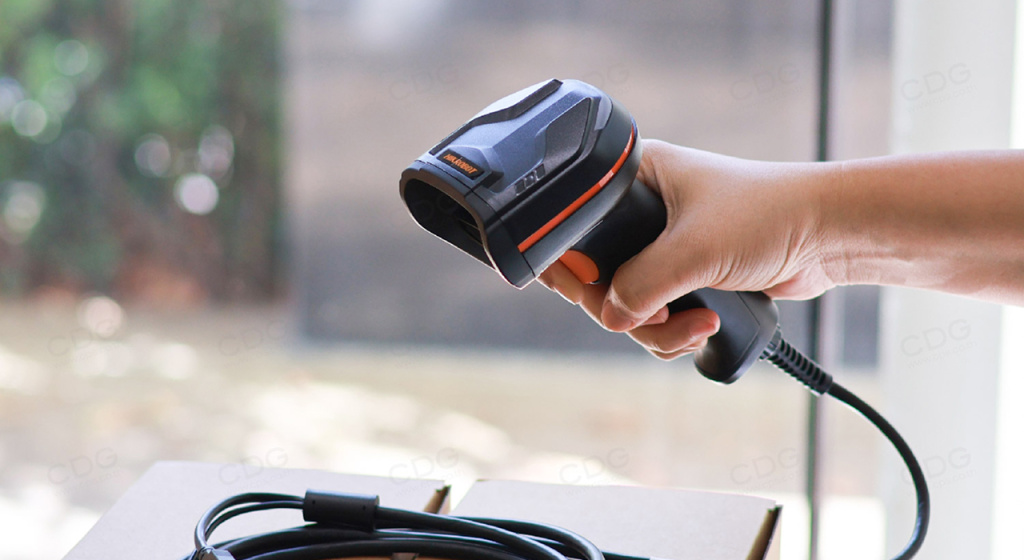
A fixed-mount barcode scanner is installed permanently at one point on a line to read codes automatically as parts pass by, without an operator involved. A handheld scanner is a portable device an operator points at a code — useful for spot checks, receiving, or any process where the item being scanned isn't moving through a fixed station.
Most inline, high-speed production and traceability tasks call for a fixed-mount reader integrated with the line's PLC or a smart camera already handling other inspection tasks, while handheld scanners suit warehouse, receiving, and lower-volume manual processes.
What Are Barcode Readers Used For? (Barcode Reader Applications)
Barcode reader applications center on product identification, quality control, and inventory tracking wherever a part or package needs to be reliably tied to its data record. Typical tasks include:
- Product and batch identification on packaging lines
- Direct part marking verification in metalworking and electronics
- Sorting and routing in warehouses and distribution centers
- Assembly verification, confirming the right component reached the right station
These tasks appear across automotive, electronics, pharmaceutical, and logistics operations — industries where full traceability from raw material to finished product is often a genuine regulatory requirement, not just an efficiency nice-to-have.
Choosing the Right Barcode Reader for Your Line
The starting point is the code itself: what symbology is already in use or planned, how much data it needs to hold, and whether it's printed on a label or marked directly onto the part. From there, environment matters — a DPM code on a reflective metal surface calls for a very different reader-and-lighting setup than a printed label on a cardboard box.
As an official Hikrobot distributor, Elvotec helps match the right reader technology to a specific code type and production environment, building on the fundamentals covered in our machine vision guide.
Frequently Asked Questions
Can one barcode reader handle both 1D and 2D codes?
Yes. Most modern image-based industrial readers decode 1D and 2D symbologies in the same device, along with OCR, so a single reader typically covers both code types on a line.
Why do some industrial parts use 2D codes instead of simple barcodes?
2D codes pack far more data into a much smaller space and tolerate partial damage better than a 1D barcode, which makes them the practical choice for small components or codes marked directly onto a part.
Is OCR the same as barcode reading?
No. Barcode reading decodes a structured code, while OCR reads printed alphanumeric characters directly — useful for checking lot numbers or expiry dates printed alongside or instead of a code.
Why are DPM codes harder to read than printed barcodes?
DPM codes rely on subtle surface contrast rather than high-contrast ink on a label, and are prone to reflections on metal parts, so they typically need an image-based reader with carefully angled lighting to read reliably.
Do I need a fixed-mount reader or a handheld scanner?
It depends on the process. Fixed-mount readers suit automated, high-speed inline reading, while handheld scanners fit manual spot checks, receiving, and lower-volume tasks where an operator handles each item.