
News
Top Benefits of Collaborative Robots for Small and Mid-Sized Manufacturers
Short answer: Cobots benefit small and mid-sized manufacturers mainly by removing the traditional barriers to automation — high capital cost, dedicated safety infrastructure, and the need for a robotics engineer on staff. A cobot can typically be installed without a large guarded cell, redeployed across different jobs as orders change, and taught a new task by an existing operator rather than a specialist programmer. For smaller manufacturers competing against larger, better-resourced competitors, that combination makes automation newly practical rather than reserved for high-volume, deep-pocketed operations.
What Makes a Cobot Different From a Traditional Industrial Robot?
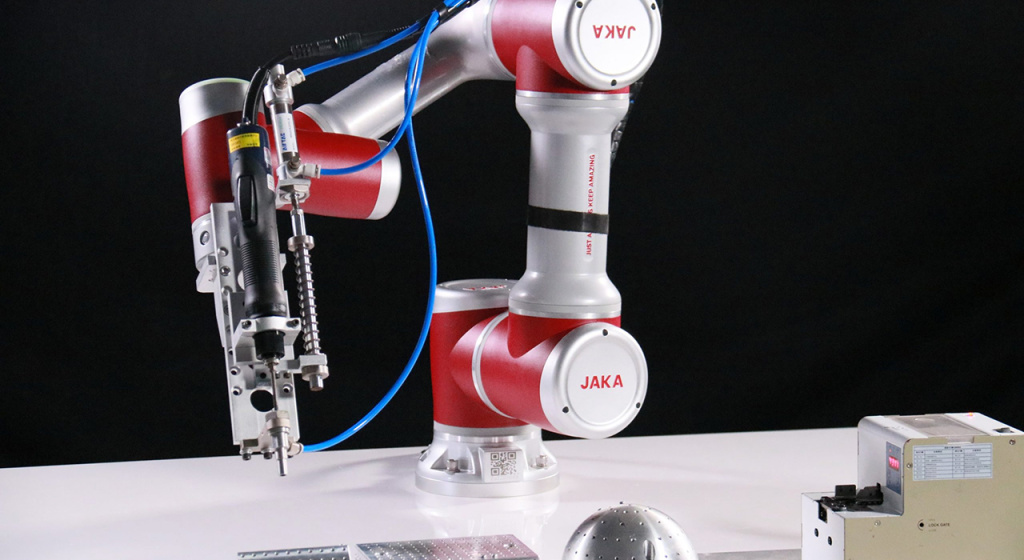
A collaborative robot, or cobot, is a robotic arm built to work directly alongside people rather than behind a fence. Built-in force sensors let it slow or stop when it meets unexpected resistance, which means many applications don't need the full perimeter guarding a traditional industrial robot requires — though whether a barrier is needed still depends on a risk assessment of the specific task. Our full guide to collaborative robots covers this distinction in more depth; the short version is that a cobot trades some raw speed and payload for the ability to share space with an operator, which is exactly the trade-off that tends to favor smaller shops.
Why Are Collaborative Robots a Good Fit for Small and Mid-Sized Manufacturers?
Collaborative robots fit small and mid-sized manufacturers because they solve the three constraints that usually rule automation out: limited floor space, limited capital, and limited in-house programming expertise. A cobot cell can often sit on a cart or a small footprint next to an existing workstation instead of requiring a dedicated, fenced-off area. It typically costs less to deploy than a full industrial robot cell once fencing, safety interlocks, and integration labor are factored in. And because many cobots are taught by hand-guiding rather than written code, an existing machine operator — not a hired robotics engineer — can often set up a new task.
None of this means a cobot replaces every form of automation. But for a manufacturer sizing up its first robot, or its third, the lower entry barrier is what makes collaborative robots for SMB operations a realistic starting point rather than an aspiration.
How Do Cobots Help With Labor Shortages?
Cobots help with labor shortages by absorbing the repetitive, physically demanding tasks that are hardest to keep staffed — machine tending, palletizing, repetitive assembly — rather than by replacing the workforce outright. A single cobot can run a repetitive station consistently across a shift, while the employees it frees up move to inspection, changeovers, or other tasks that still need human judgment.
For a small manufacturer that can't compete with larger employers on wages alone, this matters directly: fewer open, hard-to-fill positions on the most tedious jobs, and a more stable output even when staffing is tight.
Are Cobots Affordable for Small Manufacturers?
Cobots are generally more affordable for small manufacturers than traditional industrial robots, largely because of what a project doesn't need rather than a lower price on the arm itself. A traditional robot cell typically requires perimeter fencing, interlocked safety doors, and a specialized integrator to program and commission it — costs that stack on top of the robot's own price. A cobot project frequently needs less of that surrounding infrastructure, which brings the total installed cost within reach of a smaller capital budget.
That's a different question from cobot ROI for small business — how fast a specific deployment pays for itself depends on labor cost, shift structure, and the task automated, and deserves its own calculation rather than a general estimate here.
How Easy Is It to Program a Cobot in a Small Factory Without a Robotics Engineer?
Programming a cobot in a small factory is generally accessible without a dedicated robotics engineer, since most models are taught by physically guiding the arm through the motion rather than writing code from scratch. An operator moves the arm to the pick point, the place point, and any intermediate positions, and the software records the sequence.
This matters most for high-mix, low-volume production, where the same cell needs to switch between several part numbers in a day. A cobot that can be reprogrammed for a new job in minutes, by the person already running the line, fits that reality far better than a robot that needs a specialist call-out every time the product changes.
Cobots vs. Industrial Robots for Small Businesses: Which Fits Better?
For most small and mid-sized manufacturers, a cobot fits better than a traditional industrial robot — but the right choice still depends on volume and task. The table below lays out the practical trade-offs.
Cobot vs. Industrial Robot for Small Business
| Factor | Industrial Robot | Cobot |
|---|---|---|
| Safety infrastructure | Perimeter guarding typically required | Often none needed, subject to risk assessment |
| Upfront cost | Higher, including fencing and integration | Lower installed cost in most cases |
| Programming | Specialist robot programming | Often taught by hand-guiding |
| Floor space | Dedicated guarded cell | Compact, can sit alongside existing stations |
| Best fit | High-volume, unchanging production | High-mix, lower-volume, evolving production |
A high-volume manufacturer running one part around the clock may still get more value from a dedicated industrial robot. For everyone else — most small and mid-sized shops — the cobot's lower barrier to entry is usually the deciding factor.
Where Do Cobots Deliver the Most Value for Smaller Operations?
Cobots deliver the most value in smaller operations on tasks that are repetitive, physically demanding, or hard to staff consistently: machine tending, palletizing, packaging, pick-and-place, small-part assembly, and dispensing or polishing work. A compact, general-purpose model like the JAKA Zu Series covers most of these tasks without needing a specialized configuration, while the smaller JAKA Mini Series suits workshops where floor space is especially tight.
These tasks show up constantly in consumer products manufacturing and logistics and packaging operations — exactly the kind of high-mix, frequently changing work that smaller manufacturers handle every day, and where a flexible, easily reprogrammed cobot earns its keep fastest.
Getting Started With Collaborative Robots
The practical starting point is picking one repetitive, hard-to-staff task and automating that first, rather than trying to solve every station at once. Our comparison of JAKA cobot series breaks down which model — from the compact Mini Series to the mid-range JAKA A Series — fits a given payload and reach requirement.
As an official JAKA distributor, Elvotec works with small and mid-sized manufacturers to match the right cobot to a specific task, without the overhead of a full-scale robotics integration project.
Frequently Asked Questions
Do cobots really cost less than industrial robots for a small manufacturer?
Usually, once the full project is priced out. The robot itself isn't always cheaper, but skipping extensive safety fencing and specialist integration typically lowers the total installed cost.
Can a cobot be moved between different tasks as orders change?
Yes, this is one of the main advantages for smaller manufacturers. Many cobots are mounted on carts or simple stands and can be reprogrammed for a new task in a short setup session.
Do small manufacturers need a dedicated engineer to run a cobot?
Not usually. Most cobots are taught through hand-guiding rather than written programming, so an existing operator can typically set up and adjust tasks without specialist robotics training.
Are cobots fast enough for high-volume production?
They can handle solid production volumes, but a single high-volume process running at maximum speed is often still better served by a dedicated industrial robot. Cobots tend to add the most value where flexibility matters as much as raw speed.
What's the fastest way for a small manufacturer to start with cobots?
Start with a single repetitive, hard-to-staff task — machine tending or palletizing are common first applications — rather than automating an entire line at once. That keeps the initial investment and learning curve manageable.