
News
Cobot Safety Explained: How Collaborative Robots Work Without Safety Cages
Short answer: Cobots can operate without safety cages because international standards — ISO 10218 and ISO/TS 15066 — define collaborative operation modes, most commonly power and force limiting, that let a robot share workspace with people once a documented risk assessment confirms the application is actually safe. Cage-free operation isn't a property of the robot alone; it depends on the payload, speed, end-of-arm tooling, and what that risk assessment finds for the specific task.
What Does "Cobot Safety" Actually Mean?
Cobot safety means the robot, its tooling, and the surrounding task have been engineered and risk-assessed to let a person work in the same space as the robot without a physical barrier between them. It's not a single certification stamped on a robot model — it's a property of the whole application.
Traditional industrial robots move fast and carry heavy loads, so they rely on fences, cages, and light curtains to keep people out of reach while the robot operates. Collaborative robots take a different approach: they combine inherent design features — rounded edges, limited joint torque, lower operating speeds — with certified safety functions that actively monitor force, speed, or separation distance. Together, these let a cobot and a human occupy the same workspace under defined conditions, which is what makes cage-free deployment possible in the first place.
How Do Cobots Work Without Safety Cages?
Cage-free operation relies on one of four collaborative operation types defined in ISO/TS 15066: safety-rated monitored stop, hand guiding, speed and separation monitoring, and power and force limiting. Only the last two actually allow a robot and a person to move in the same space at the same time — the first two still separate their movements in time, even without a full cage.
The Four Collaborative Operation Types
| Operation Type | How It Works | Robot & Human Move Simultaneously? |
|---|---|---|
| Safety-rated monitored stop | Robot halts fully before a person enters its space | No |
| Hand guiding | Operator directly commands robot motion via a control device | Yes, but operator-led |
| Speed and separation monitoring | Sensors track distance and slow or stop the robot as a person approaches | Yes, at reduced speed |
| Power and force limiting | Robot's force and power stay under injury thresholds; it stops on excess contact force | Yes, at full task speed |
What Is Power and Force Limiting, and Why Is It the Default Cobot Safety Mode?
Power and force limiting is the most common cobot safety mode because it needs no external sensors — the limits are built into the robot's own design and control system. The robot restricts the force and pressure it can exert on contact to stay under the injury thresholds set out in ISO/TS 15066, and it stops automatically if a collision exceeds those limits.
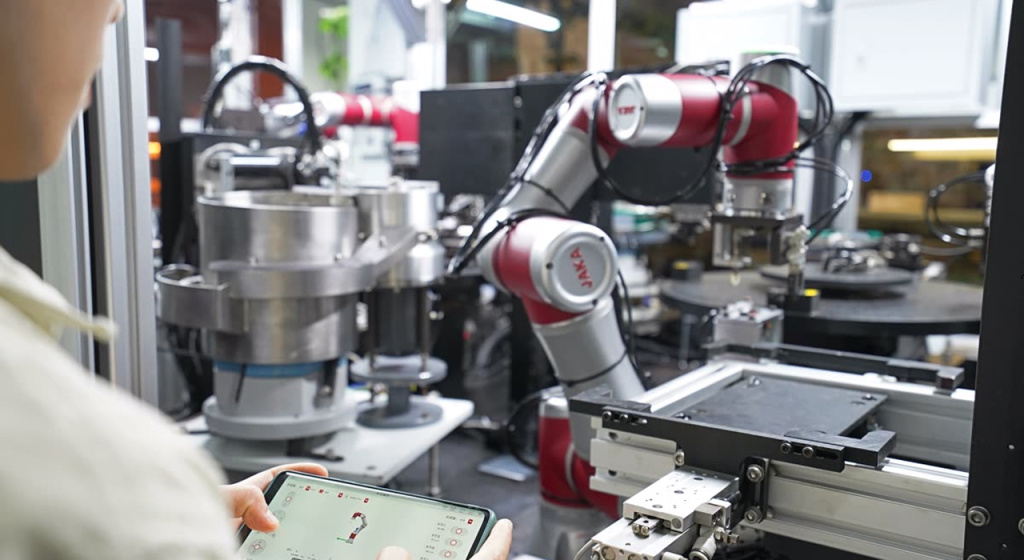
This is the mode most commercial cobots, including the JAKA Zu Series, are designed around by default. It's what allows a cobot to work directly alongside an operator on a shared table without a fence — but the limits only hold for the robot arm itself. Payload, speed, and especially the end-of-arm tooling all factor into whether the application stays within safe contact-force limits, which is why the same robot can be compliant in one cell and non-compliant in another.
What Is Speed and Separation Monitoring, and When Is It Used?
Speed and separation monitoring uses external sensors — typically safety-rated laser scanners or lidar — to track how close a person is to the robot and adjust its speed accordingly, slowing or stopping it as the distance closes. It's used when a task needs more speed or payload than power and force limiting alone can safely allow, letting the robot still run cage-free in a monitored zone rather than at a fixed reduced speed all the time.
In practice, this means adding dedicated safety hardware around the cell — area scanners like those from SDKELI or lidar sensors from Akusense are the kind of equipment used to create these monitored zones in mixed human-robot lines.
What Are ISO 10218 and ISO/TS 15066, and How Do They Differ?
ISO 10218 is the base safety standard for industrial robots and robot systems, split into a part for manufacturers (robot design) and a part for integrators (how the robot is installed into a cell). ISO/TS 15066 is a technical specification written specifically to supplement ISO 10218 for collaborative applications — it's where the four operation types above, and the specific force and pressure limits behind power and force limiting, are defined.
The 2025 revision of ISO 10218 folds the ISO/TS 15066 content directly into the main standard rather than keeping it as a separate document, and shifts the terminology from "collaborative robot" to "collaborative application" — a deliberate signal that safety is confirmed for a specific task and cell, not certified once for a robot model in general.
What Does a Cobot Risk Assessment Actually Involve?
A cobot risk assessment evaluates the specific installation — payload, speed, end-of-arm tooling, workpiece shape, and cell layout — rather than relying on a generic safety rating for the robot itself. It's what determines whether power and force limiting alone is sufficient, or whether speed and separation monitoring (or a partial guard) needs to be added.
For manufacturers placing equipment on the EU market, this assessment currently sits under the Machinery Directive 2006/42/EC and its harmonized standards, with the Machinery Regulation (EU) 2023/1230 replacing it from January 2027 onward. CE marking for a robot cell depends on this documented assessment being carried out and kept on file — not just on the robot manufacturer's own safety data sheet.
Are Cobots Safe to Work Next to Humans?
Yes, when the specific application has been properly risk-assessed and integrated to the standards above — but that safety comes from the whole setup, not a blanket guarantee on the robot model. The gripper or tool mounted on the arm is part of that equation: a sharp or heavy end-of-arm tool can turn an otherwise compliant power-and-force-limited robot into a hazard, which is why gripper choice and mounting are reviewed as part of the same risk assessment, not treated separately from it.
What Safety Sensors and Devices Do Cobot Applications Actually Use?
Beyond the force limits built into the robot arm itself, most real cobot cells add external hardware to cover conditions the arm's own limits don't handle — nearby forklifts, mobile equipment, or a faster process step elsewhere in the line. Safety-rated laser scanners and lidar sensors are the most common addition, creating monitored zones that slow or stop equipment as a person approaches, and are typically paired with e-stops and safety-rated control relays.
This layered approach shows up most often in mixed-line environments — automotive assembly cells and electronics production lines both commonly combine a power-and-force-limited cobot with area-monitoring sensors around it, rather than relying on either measure alone.
Collaborative Robot vs. Industrial Robot Safety: What's the Real Difference?
Comparing Safety Approaches
| Aspect | Industrial Robot | Collaborative Robot (Cobot) |
|---|---|---|
| Typical safeguarding | Fixed fence, cage, or light curtain | Risk-assessment-dependent; often cage-free |
| Speed and force | High, generally unrestricted | Limited or actively monitored |
| Shared workspace with people | No — safety-rated stop only | Yes, under power and force limiting or speed and separation monitoring |
| Governing standards | ISO 10218 | ISO 10218 plus ISO/TS 15066 |
The fundamentals of what makes a robot "collaborative" in the first place are covered in our guide to collaborative robots; this article focuses specifically on the safety mechanics behind that classification.
How Should Manufacturers Approach Cobot Safety in Practice?
A sound approach starts with the task, not the robot. First, define the actual application — payload, speed, tooling, and cell layout — since that's what gets risk-assessed, not the robot in isolation. Second, carry out and document a risk assessment aligned with ISO 10218 and the collaborative provisions from ISO/TS 15066. Third, choose the operation mode the assessment supports: power and force limiting alone for lighter, slower tasks, or power and force limiting combined with speed and separation monitoring where more speed or payload is needed. Fourth, add engineering controls — scanners, monitored zones, guarding — only where the assessment shows the built-in limits aren't enough on their own.
Our comparison of JAKA cobot series is a practical next step for matching a power-and-force-limited model to a specific payload and speed target once these safety requirements are defined.
Frequently Asked Questions
Do all cobots operate without any safety cage at all?
Not automatically. Whether a cage is needed depends on the risk assessment for that specific application — payload, speed, and tooling all factor in, so the same cobot model can run cage-free in one cell and require partial guarding in another.
What's the difference between ISO 10218 and ISO/TS 15066?
ISO 10218 is the base safety standard for industrial robots and robot systems; ISO/TS 15066 is a supplementary specification written specifically for collaborative applications, defining the four collaborative operation types and the force limits behind them. The 2025 revision of ISO 10218 has folded this collaborative content directly into the main standard.
Can a cobot become unsafe if paired with the wrong gripper or tooling?
Yes. Power and force limits are validated for the robot arm, but a heavy, sharp, or poorly mounted gripper can push the total contact force above safe thresholds, which is why end-of-arm tooling is assessed as part of the same risk assessment as the robot itself.
Is a risk assessment legally required for every cobot installation in the EU?
Yes. CE marking for a robot cell in the EU depends on a documented risk assessment under the Machinery Directive today, with the Machinery Regulation (EU) 2023/1230 applying from January 2027 — it isn't optional paperwork, but a condition of placing the equipment on the market.
What happens if a cobot detects too much force during operation?
Under power and force limiting, the robot stops automatically once contact force or pressure exceeds the thresholds set out in ISO/TS 15066, rather than continuing to move through the obstruction.