
News
Machine Vision Code Reading for Traceability: A Practical Guide
Short answer: Machine vision code reading uses a camera and decoding software to read 1D and 2D codes on products, labels and packages, then links each item to its data. It tracks parts through production and shipping, and unlike a laser scanner it can read several codes at once and handle codes at different angles. Success depends on the right code type, good lighting and enough resolution.
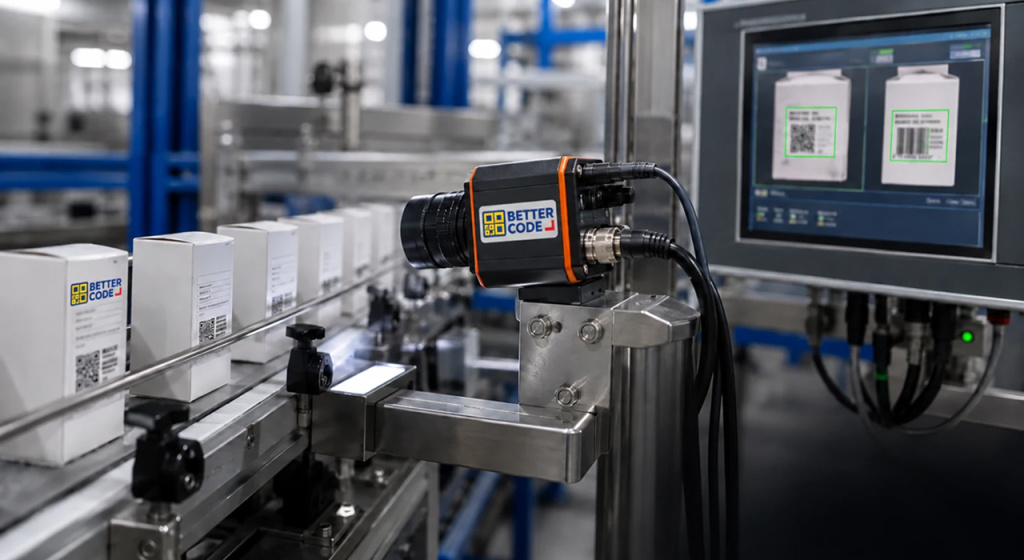
What Is Machine Vision Code Reading?
Machine vision code reading is the process of capturing an image of a code and decoding it with software. The decoded data identifies the item: a serial number, batch, date or destination.
This is the foundation of machine vision traceability: every code read is a record of where a part has been. If you are new to the technology, start with what machine vision is.
Industrial Barcode Reader vs Barcode Scanner: What Is the Difference?
A traditional barcode scanner uses a laser line. An image-based reader uses a camera and decoding software. Balluff describes traditional readers as red line laser scanners or cameras with decoding and positioning software. It credits vision code readers with higher read rate performance, multi-directional code detection, simultaneous reading of multiple codes and greater information storage.
In practice, that makes image-based readers the natural choice when codes are small, vary in position or arrive in groups.
1D vs 2D Barcode Reading: Which Code Types Matter?
1D codes are the traditional "ladder line" barcodes. 2D codes are smaller but hold more information and include built-in redundancy in case of scratches or defacement.
- Data Matrix: compact, high capacity and still readable when partly damaged.
- QR code: holds more data than Data Matrix. It was first developed to track parts in vehicle manufacturing.
- Micro QR: used on items such as camshafts, pistons and circuit boards. Balluff notes that micro QR codes typically require an industrial sensor.
How Does DataMatrix Code Reading Support Traceability?
DataMatrix reading links each part to its record in a single scan. Because the code is compact and tolerates damage, it fits small parts and harsh lines.
With one code per part, a defect found later can be traced back to a batch, a station or a time. This is why code reading pairs naturally with inspection, as covered in how machine vision improves quality control.
What Is Direct Part Marking (DPM) Code Reading?
Direct part marking means the code is marked on the part itself instead of on a label. Vision Systems Design lists laser etching, electrochemical etching, dot-peening and ink-jet printing. It says these methods apply to metal, plastic, glass, ceramic and rubber, and that Data Matrix is the standard format.
DPM is harder to read than a printed label. Etched and dot-peened marks have low contrast, and the reader must tolerate wide variation in mark appearance. The same article notes that off-axis illumination suits low-contrast marks.
How Is Code Reading Used for PCB Traceability in Electronics?
On printed circuit boards, small laser-marked Data Matrix codes store large amounts of data in very little space. Dynamsoft notes that a single scan can give access to component details within seconds and reduce manual entry errors. It also points out that codes can be as small as 1×1 mm, so reading them accurately is a challenge.
Small codes call for high resolution and careful lighting. A good starting point is area scan cameras. The wider context is in the electronics industry.
How Is Barcode Reading Used in Logistics?
In logistics, vision reads parcel labels on moving conveyors so sorters can send each item to the right destination. IMV Europe reports that DHL replaced laser scanners with camera-based parcel recognition at three Spanish hubs. The system uses line-scan cameras on powered conveyors, and the source says read rates are approaching 100 per cent, including damaged codes and codes behind reflective packaging.
For continuous webs and fast conveyors, see area scan vs line scan cameras. More examples are on the logistics applications page.
Can Machine Vision Read Text Too (OCR)?
Yes. Optical character recognition (OCR) reads printed characters rather than bars or modules. It is useful when a part carries both a code and human-readable text, or as a cross-check on the code content.
How Can You Improve Barcode Read Rate?
To improve read rate, control the three things you can: the mark, the light and the image.
- Mark quality: use a consistent marking method. Dot-peened parts may need stricter verification than label standards provide.
- Lighting: match the technique to the surface and the mark. Low-contrast marks often need off-axis illumination.
- Resolution: make sure the code covers enough pixels, especially for codes only a few millimeters across.
- Orientation: use a reader that detects codes in any direction.
- Software: confirm the vision system supports the code types you use.
What Hardware Do You Need?
For a compact single station, Hikrobot smart cameras combine imaging and processing in one unit. Multi-camera lines can use vision controllers to process several cameras together. In both cases, check that the software supports code reading tools. You can browse the full range of machine vision cameras to match resolution and speed to your codes.
Frequently Asked Questions
What is the difference between a barcode scanner and an image-based reader?
A scanner uses a laser line. An image-based reader uses a camera and software, so it can read several codes and different angles.
Which is better for traceability: 1D or 2D codes?
2D codes hold more data in less space and tolerate damage better, which suits small parts.
Why is DPM code reading difficult?
Etched or dot-peened marks have low contrast and vary in appearance, so lighting and software must tolerate variation.
Can machine vision read damaged codes?
Often yes. 2D codes include redundancy, and in the DHL case the system reads damaged codes and codes behind reflective packaging.
What is OCR in machine vision?
OCR reads printed characters. It complements code reading when text appears next to a code.