
News
MV-ID2023XM Industrial Code Reader: Compact 2.4 MP Reader for Difficult Codes on PCBs, Batteries and Metal Parts
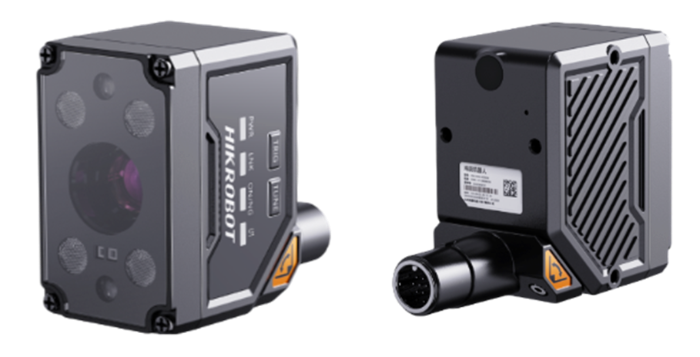
Short answer: The MV-ID2023XM is a compact 2.4 MP industrial code reader from Hikrobot, built to read difficult 1D and 2D codes — stained, skewed, low-contrast or laser-marked on metal — at up to 80 codes per second. It combines a global-shutter CMOS sensor with Hikrobot's deep learning algorithm, a 4-channel light source and IP65 protection in a body of about 118 g. The MV-ID2023XM series comes in 14 models with Ethernet or USB connectivity and mechanical or liquid-lens focusing, so you can match it to your working distance and control system.
What Is the MV-ID2023XM Code Reader?
The MV-ID2023XM is a fixed-mount industrial code reader: a compact device with its own image sensor, lens, lighting and decoding software that reads codes on parts as they pass through a production line. It sends the decoded result to a PLC, PC or other control system instead of sending images for a person to review.
The MV-ID2023XM series of industrial code readers is a mini format in Hikrobot's range, intended for consumer electronics, PCB, automotive, lithium battery and photovoltaic manufacturing.
Two terms are useful here:
- 1D and 2D codes: 1D codes (barcodes) store data in a row of bars; 2D codes such as Data Matrix and QR store it in a grid, which fits more data into a smaller area. Our guide to industrial barcode readers: 1D, 2D and OCR explains the differences in detail.
- Direct part marking (DPM): a code applied directly to the part — for example, laser-marked onto metal — instead of printed on a label. DPM codes are often low-contrast and reflective, which makes them harder to read.
Which Difficult Codes Can the MV-ID2023XM Read?
The reader is designed for codes that standard scanners often fail on: stained codes, skewed codes, low-contrast codes and codes on laser-marked metal surfaces. Three features work together to make this possible.
Deep learning decoding. Hikrobot's deep learning algorithm processes images with high robustness, which helps the reader recognize complex and damaged codes.
Digital WDR image processing. Wide dynamic range (WDR) processing balances very bright and very dark areas in the same image. This matters on shiny metal, where reflections and shadows sit side by side.
Configurable lighting and optics. Lighting often decides whether a code is readable at all, especially on metal. The MV-ID2023XM gives you several options:
- 4-channel light source control;
- red light by default, with white, blue, IR, UV and two-color (red/blue) lights as options;
- a half-polarized lens cap by default, with transparent and fully polarized caps as options — polarization helps reduce glare on reflective surfaces;
- an aiming system with 2 green LEDs for quick positioning.
If you are planning the optics for a new station, our guide to choosing machine vision lens and lighting covers the principles behind these choices.
Which Symbologies Does It Support?
The MV-ID2023XM reads the most common industrial 1D, 2D and stacked codes, including GS1 variants.
| Code type | Supported symbologies |
|---|---|
| 1D codes | Code 39, Code 93, Code 128 (incl. GS1-128), CodaBar, EAN 8, EAN 13, UPC-A, UPC-E, ITF 14, ITF 25, Matrix 25, MSI, China Post, Code 11, Industrial 2 of 5, Pharmacode (one/two-track) |
| 2D matrix codes | QR Code (incl. GS1 QR), Data Matrix (incl. GS1 DataMatrix), Micro QR, Aztec, Han Xin |
| Stacked codes | PDF417, MicroPDF417 |
Where Is the MV-ID2023XM Used?
The datasheet lists consumer electronics, PCB, automotive, lithium battery and photovoltaic production as the main application areas. In all of them, parts are tracked individually through many process steps, and stations often leave little room for a reader.
- Electronics and PCB assembly: compact boards and components leave little room for a reader or for large codes. The small housing and close working distances suit this kind of electronics manufacturing station.
- Automotive parts: laser-marked codes on metal components are a typical DPM task in automotive production.
- Lithium battery and photovoltaic production: both rely on part-level identification across many process steps.
In all of these, the reader's job is the same: capture a reliable ID at each station so every part can be traced. For the bigger picture, see our guide to machine vision code reading for traceability.
Which MV-ID2023XM Model Should You Choose?
The right model depends on three choices: focusing type, interface and focal length. All 14 MV-ID2023XM code readers share the same sensor, decoding performance and housing.
| Focusing | Interface | Focal lengths | Model code pattern |
|---|---|---|---|
| Mechanical (M12 mount) | Ethernet | 5, 8, 12, 16 mm | MV-ID2023XM-05/08/12/16M-RBN |
| Mechanical (M12 mount) | USB | 5, 8, 12, 16 mm | MV-ID2023XM-05/08/12/16M-RBN-U |
| Liquid lens (D14 mount) | Ethernet | 8, 12, 16 mm | MV-ID2023XM-08/12/16L-RBN |
| Liquid lens (D14 mount) | USB | 8, 12, 16 mm | MV-ID2023XM-08/12/16L-RBN-U |
Mechanical Focus or Liquid Lens?
Choose mechanical focus for a fixed station where the distance to the code never changes. Choose a liquid lens when you need more flexibility.
- Mechanical focus: the focus is set once on the M12-mount lens.
- Liquid lens: a lens whose focus is adjusted electrically rather than by turning the lens. In the datasheet's detection tables, the 8 mm and 12 mm liquid-lens models reach working distances of up to 2,000 mm, while the mechanical-focus models are listed up to 1,000 mm.
Ethernet or USB?
Choose the Ethernet version for integration into a factory network or PLC; choose USB for a simple connection to a PC. The Ethernet models use Fast Ethernet (100 Mbit/s), which is sufficient for sending decoded results. USB models use USB 2.0 and need a separate DC power supply.
Which Focal Length Fits Your Distance?
Shorter focal lengths give a wider field of view at close range; longer ones cover small codes from further away. A few values from the datasheet for the mechanical-focus models:
| Focal length | Working distance | Field of view (H × V) | Min. 2D code element |
|---|---|---|---|
| 5 mm | 100 mm | 84 × 56 mm | 0.13 mm |
| 8 mm | 300 mm | 158 × 106 mm | 0.25 mm |
| 12 mm | 100 mm | 35 × 23 mm | 0.06 mm |
| 16 mm | 1,000 mm | 264 × 176 mm | 0.41 mm |
The full detection-range tables are in the MV-ID2023XM datasheet.
How Does the MV-ID2023XM Integrate into Automation Systems?
The Ethernet models support a wide set of industrial protocols, so results can be sent to a PLC or host system over a protocol the line already uses.
- Network models: SmartSDK, TCP Client, TCP Server, Serial, FTP, PROFINET, EtherNet/IP, MELSEC/SLMP, Modbus, FINS and UDP.
- USB models: SmartSDK and USB (CDC, HID).
A 17-pin M12 connector carries power and I/O: two isolated inputs, two isolated outputs and one RS-232 port. The reader can also be triggered with a side button, which is handy during setup.
Setup is handled in the IDMVS client software. With IDMVS V5.0.0 and later, the reader supports auto focusing and one-click tuning, which shortens commissioning. Status LEDs for power, network, OK/NG result and a user-defined signal make diagnosis on the line easier.
What Are the Key Specifications?
| Parameter | MV-ID2023XM series |
|---|---|
| Resolution | 1920 × 1280 (2.4 MP) |
| Sensor | CMOS, global shutter, mono, 1/3.52", 2.2 µm pixels |
| Max. frame rate | 60 fps |
| Max. reading speed | 80 codes/sec |
| Exposure time | 36 µs to 100 ms |
| Gain | 0 dB to 48 dB |
| Data interface | Fast Ethernet (100 Mbit/s) or USB 2.0 |
| Power | 24 VDC; avg. 5 W, max. 12 W (light source enabled) |
| Dimensions | 2.9" × 1.2" × 1.6" straight / 2.0" × 1.2" × 2.4" right angle |
| Weight | Approx. 0.3 lb (118 g) |
| Protection | IP65 |
| Certification | CE, RoHS, KC |
A global shutter exposes all pixels at the same moment, so codes on moving parts are captured without the distortion a rolling shutter can cause.
Is the MV-ID2023XM Built for Harsh Production Environments?
Yes — within its rated limits. The reader carries an IP65 rating, meaning it is dust-tight and protected against water jets. It operates from 32 °F to 122 °F (0 °C to 50 °C) and at 20% to 95% relative humidity without condensation.
It is also tested for vibration (IEC 60068-2-6) and shock (IEC 60068-2-27), which matters on machines and conveyors that move constantly.
Mounting is flexible. The modular design, rotatable and separated cable, and multi-surface mounting interfaces let you fit the reader in tight spaces. It is available in straight-angle and right-angle versions, and an installation bracket is included in the package; cables are purchased separately.
Two practical notes from the datasheet: USB-type devices need a DC power supply, and UV or IR light sources should be used with a transparent lens cap (without lamp cup) to prevent the plastic from becoming brittle. Avoid direct eye exposure to UV and IR light.
How Does It Fit into the Hikrobot Code Reader Range?
The MV-ID2023XM is a mini reader designed for compact installations. If your application needs a different field of view or reading distance, the full range of Hikrobot barcode readers covers other formats, and the ID800 series is another compact option.
Code reading is one part of a broader machine vision strategy, and the reader should be chosen together with the lighting and the control system it will connect to. To discuss the right model for your line, contact ELVOTEC, an official Hikrobot distributor.
Frequently Asked Questions
What is the resolution of the MV-ID2023XM?
The MV-ID2023XM has a 2.4 MP resolution of 1920 × 1280 pixels, using a monochrome CMOS sensor with a global shutter and 2.2 µm pixels.
How fast can the MV-ID2023XM read codes?
It reaches a maximum reading speed of 80 codes per second and a maximum frame rate of 60 fps.
Can the MV-ID2023XM read codes on metal?
Yes. It is designed to read difficult codes, including codes on laser-marked metal surfaces, using deep learning decoding, WDR image processing, configurable lighting and polarized lens caps.
What is the difference between the Ethernet and USB models?
Ethernet models connect via Fast Ethernet and support industrial protocols such as PROFINET, EtherNet/IP and Modbus. USB models connect via USB 2.0, support SmartSDK and USB (CDC, HID), and need a separate DC power supply.
What is the maximum working distance?
The datasheet lists up to 1,000 mm for mechanical-focus models and up to 2,000 mm for the 8 mm and 12 mm liquid-lens models.