
News
What Is a SWIR Camera? How Short-Wave Infrared Imaging Works in Machine Vision
Short answer: A SWIR camera is a camera that images short-wave infrared light — most commonly wavelengths between about 900 and 1,700 nm, beyond what the human eye and standard silicon sensors can see. It uses a dedicated sensor, usually made of indium gallium arsenide (InGaAs), and works with reflected light, much like a visible-light camera. In SWIR, some materials that look opaque become transparent, water shows up strongly, and similar-looking materials can be told apart — which is why SWIR imaging is used for semiconductor, food, recycling and quality-control tasks that ordinary cameras cannot solve.
What Is a SWIR Camera?
A SWIR camera (short-wave infrared camera) is an industrial or scientific camera whose sensor is sensitive to the short-wave infrared part of the spectrum. It produces an image that looks similar to a monochrome photograph, but shows how objects reflect and absorb infrared light instead of visible light.
Key terms:
- SWIR (short-wave infrared): the infrared band just beyond visible and near-infrared light. Edmund Optics defines it as typically 0.9–1.7 µm, while noting that broader definitions extend from 0.7 to 2.5 µm.
- InGaAs (indium gallium arsenide): the semiconductor material used in most SWIR sensors.
- Reflected vs emitted light: SWIR cameras see light reflected by objects; thermal cameras see heat emitted by objects.
A SWIR camera is still a machine vision camera: it is triggered, connected to vision software and used to inspect, measure or sort parts. What changes is the part of the spectrum it works in — and therefore what it can see.
How Does a SWIR Camera Work?
A SWIR camera works like a visible-light camera that has been moved further along the spectrum. Light reaches the object, part of it is reflected, and the lens focuses that reflected SWIR light onto a sensor that can detect it.
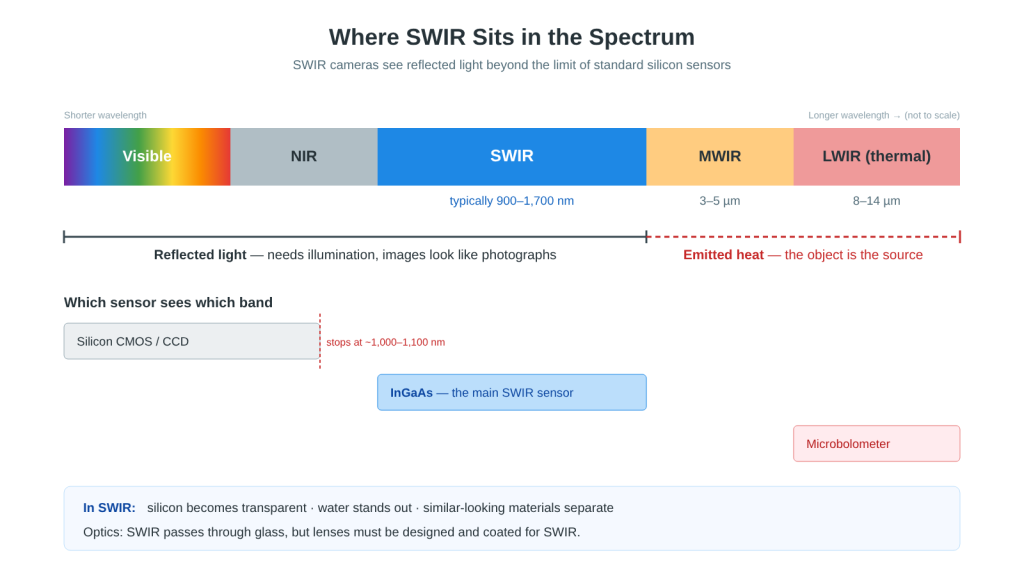
Three components make this possible:
- The sensor. Standard silicon CMOS and CCD sensors stop responding at around 1,000–1,100 nm. A SWIR camera therefore uses a dedicated sensor, most often InGaAs, which covers the short-wave infrared range. Mercury cadmium telluride (MCT) sensors extend the range further but are usually more expensive and more application-specific, according to Axiom Optics.
- The optics. SWIR light passes through glass, so lenses, windows and filters can be made with the same techniques as visible optics. However, lenses must be designed and coated for SWIR: a visible-only lens gives lower resolution and more aberrations in this band.
- The illumination. Because SWIR imaging relies on reflected light, the scene must contain SWIR light. On a production line, that normally means SWIR illumination chosen for the task.
The result is an image with shadows, edges and contrast — sharp enough for inspection and measurement, but recorded in a part of the spectrum where materials behave differently.
Why Do Materials Look Different in SWIR Imaging?
Materials reflect, absorb and transmit SWIR light differently from visible light. That difference is the whole value of SWIR imaging: it reveals properties that a visible camera cannot capture.
Examples reported by camera and optics specialists include:
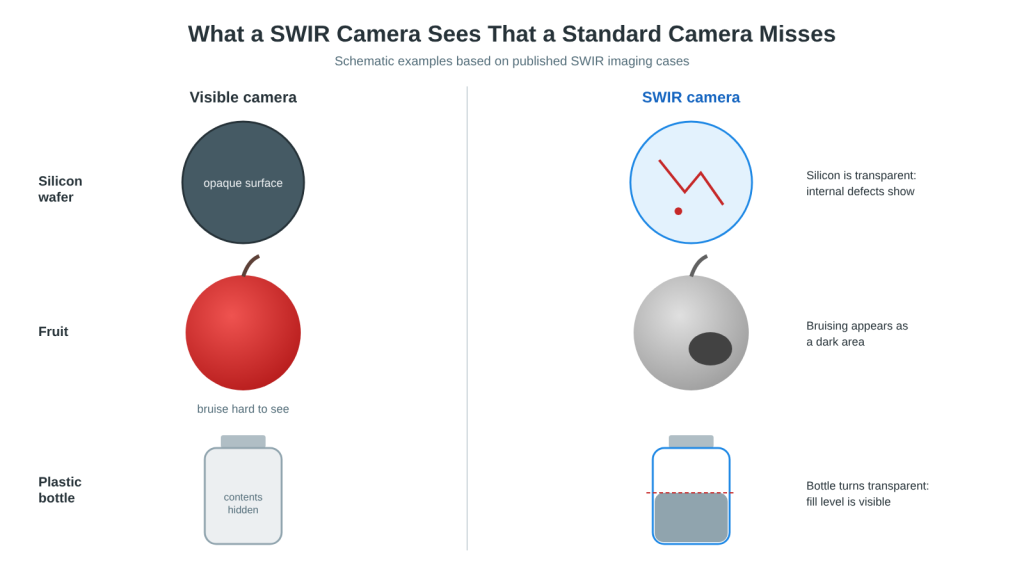
- Silicon becomes transparent. Silicon transmits SWIR light, so a SWIR camera can look into silicon wafers and solar cells. 1stVision also cites SWIR for finding tiny surface defects on silicon circuits.
- Water stands out. According to the same source, SWIR imaging can reveal water accumulation inside fruit.
- Hidden defects appear. Edmund Optics shows bruising on a red apple that is clearly visible in SWIR but hard to see in visible light.
- Some containers become see-through. In the same source, a plastic baby powder bottle appears transparent in SWIR, so the powder level inside is visible.
- Similar colours separate. Materials that look nearly identical in visible light can be distinguished in SWIR.
- Haze and fog matter less. Water vapour and fog are transparent in SWIR.
What Is the Difference Between SWIR, NIR and Thermal Cameras?
SWIR sits between near-infrared (NIR) and thermal infrared, and it behaves more like visible light than like thermal imaging. The key distinction is whether the camera sees reflected light or emitted heat.
| NIR (with silicon sensor) | SWIR | Thermal (LWIR) | |
|---|---|---|---|
| What the camera sees | Reflected light | Reflected light | Emitted heat |
| Typical sensor | Silicon CMOS | InGaAs | Microbolometer (VOx or a-Si) |
| Range | Up to about 1,000–1,100 nm (silicon limit) | Typically 900–1,700 nm | 8–14 µm |
| Needs illumination | Yes | Yes | No — the object is the source |
| Cooling | No | Uncooled | Uncooled |
| Typical uses | Standard machine vision up to the silicon limit | Semiconductor inspection, moisture and material identification, counterfeit detection | Thermal surveillance, building and automotive diagnostics |
Sources: Axiom Optics; Edmund Optics.
In short: choose SWIR when you need to see what something is made of or contains; choose thermal when you need to see how hot it is. For thermal tasks, long-wave infrared cameras such as the Hikrobot CI long-wave infrared camera are the relevant category, not SWIR.
What Are the Main SWIR Camera Applications in Machine Vision?
SWIR machine vision is used where the defect, the material or the contents are invisible to standard cameras. The applications named by Edmund Optics, Axiom Optics and 1stVision fall into five groups.
Semiconductor and Electronics Inspection
Because silicon is transparent in SWIR, a SWIR camera can inspect silicon wafers, solar cells and electronic boards from within, rather than only at the surface. All three sources cite this group of SWIR camera applications, and it is a natural fit for electronics manufacturing.
Food and Produce Inspection
SWIR imaging reveals bruising and water accumulation in fruit that visible cameras miss. That makes it useful for produce inspection and sorting on food and beverage lines, where hidden defects affect quality grading.
Moisture Detection and Material Identification
SWIR cameras are used to detect moisture and to identify materials that look alike in visible light. Recycling is a named application area, where telling materials apart is the core task.
Process and Quality Control
SWIR can show contents through some containers — as in the powder-bottle example — and supports metal and glass inspection. These tasks extend quality control to features a standard camera cannot reach.
Security and Anti-Counterfeiting
Edmund Optics and Axiom Optics both list counterfeit detection and surveillance, including outdoor night imaging using natural SWIR sources such as nightglow and starlight.
How Do You Choose a SWIR Camera for Machine Vision?
Start from the material property you need to see, then match the camera, optics and lighting to it. A SWIR system only works if all three are designed for the same wavelength band.
- Confirm that SWIR is needed. If the feature is visible to a standard camera, a silicon-based camera is simpler. SWIR earns its place when the defect, material or contents are invisible in visible light.
- Check the wavelength range. Most SWIR cameras cover about 900–1,700 nm; some tasks need extended ranges and different sensors.
- Choose the camera format. Area scan suits discrete parts; line scan suits continuous materials and sorting belts. Our comparison of area scan vs. line scan cameras explains the trade-offs.
- Use SWIR-rated optics. Lenses must be designed and coated for SWIR; visible lenses lose resolution.
- Plan the illumination. SWIR imaging depends on reflected light, so the light source must emit in the right band. The general principles are covered in our guide to machine vision lens and lighting.
- Test with real samples. Material behaviour in SWIR varies, so validate contrast on actual good and bad parts before committing.
Which SWIR Cameras Are Available for Industrial Use?
Industrial SWIR cameras are also available as area scan models for machine vision. In the Hikrobot range, the MV-CI050-Y1S-NN is a 5 MP industrial area scan camera for the short-wave infrared range.
It sits within the wider Hikrobot area scan camera portfolio, so SWIR and standard cameras for the same line can come from one supplier. As an official Hikrobot distributor, ELVOTEC helps manufacturers across Hungary and Central and Eastern Europe evaluate whether SWIR solves their inspection task — contact our team to discuss your application.
Frequently Asked Questions
What is a SWIR camera used for?
A SWIR camera is used to see material properties that visible cameras miss: inspecting inside silicon wafers and solar cells, finding hidden bruising or water in food, identifying and sorting materials, and detecting counterfeits.
What wavelength does a SWIR camera detect?
Most SWIR cameras detect about 900–1,700 nm. Broader definitions of the SWIR band extend from 0.7 to 2.5 µm.
Is a SWIR camera a thermal camera?
No. A SWIR camera sees reflected light, like a visible camera, and needs illumination. A thermal camera sees heat emitted by objects in the mid- or long-wave infrared range.
Why can't a normal camera see SWIR light?
Standard cameras use silicon sensors, which stop responding at around 1,000–1,100 nm. SWIR cameras use InGaAs sensors that are sensitive in the short-wave infrared range.
Do SWIR cameras need special lenses?
Yes. SWIR light passes through glass, but lenses must be designed and coated for SWIR. A lens made only for visible light gives lower resolution and more aberrations.