
News
What Is an LWIR Camera? How Long-Wave Infrared Thermal Imaging Works in Machine Vision
Short answer: An LWIR camera is a thermal camera that detects long-wave infrared radiation, generally in the 8–14 µm range. Instead of recording reflected light, it measures the heat that objects emit themselves, so it needs no illumination and works in complete darkness. Most LWIR cameras use an uncooled microbolometer sensor made of vanadium oxide (VOx) or amorphous silicon (a-Si) and lenses made of infrared-transparent materials such as germanium. In industry, LWIR cameras are used for thermal inspection, process monitoring and predictive maintenance – tasks where temperature, not appearance, tells you whether something is right.
What Is an LWIR Camera?
An LWIR camera (long-wave infrared camera) is an imaging device that turns the thermal radiation emitted by objects into an image. Warmer areas emit more radiation and appear brighter or in a different colour; cooler areas appear darker.
Key terms:
- LWIR (long-wave infrared): the infrared band generally considered to be between 8 and 14 µm.
- Thermal radiation: infrared energy that every object emits because of its temperature.
- Microbolometer: a heat-sensitive sensor element that changes its electrical properties when it absorbs infrared radiation.
- Uncooled: a detector that works at or near room temperature, without cryogenic cooling.
In a machine vision system, an LWIR camera plays the same role as any industrial camera – it captures images for software to analyse. The difference is the information in those images: a standard camera shows shape, colour and texture, while an LWIR thermal camera shows how heat is distributed across a part, a machine or a process.
What Is the Long-Wave Infrared Wavelength Range?
The long-wave infrared wavelength range is generally defined as 8–14 µm. Some camera manufacturers specify slightly different limits, for example 7.5–14 µm, depending on the detector.
This band is used for thermal imaging for two reasons:
- It matches the heat of everyday objects. According to LightPath, objects at around 300 K – roughly room temperature – emit their peak thermal radiation in the LWIR band. That makes LWIR well suited to imaging people, machines and products at normal operating temperatures.
- The atmosphere transmits it well. The 8–14 µm range falls within an atmospheric transmission window, so relatively little of the radiation is absorbed between the object and the camera.
For comparison, short-wave infrared (SWIR) typically covers about 0.9–1.7 µm and mid-wave infrared (MWIR) 3–5 µm.
How Does an LWIR Thermal Camera Work?
An LWIR thermal camera works by focusing the infrared radiation emitted by a scene onto an array of heat-sensitive detectors, which convert it into an electrical signal and then into an image. No light source is involved – the object itself is the source.
The Microbolometer Sensor
Most LWIR cameras are built around a microbolometer array. Each element absorbs incoming infrared radiation, warms up slightly and changes its electrical resistance. The camera reads these changes pixel by pixel and builds a thermal image.
The two common microbolometer materials are vanadium oxide (VOx) and amorphous silicon (a-Si). Because they work at or near room temperature, a microbolometer thermal camera avoids the coolers used in other infrared bands. LightPath gives typical sensitivity for uncooled LWIR in the 30–50 mK range.
Infrared Optics
Ordinary glass cannot be used for LWIR lenses. As Teledyne FLIR explains, glass is transparent to visible light but opaque in the infrared. LWIR lenses are therefore made from germanium or other materials with low absorption in the infrared spectrum. This is a key difference from visible and SWIR cameras, which can use glass optics.
From Image to Temperature Data
Some LWIR cameras simply show relative heat differences; radiometric cameras are calibrated to report temperature values. In both cases, the reading depends on the surface: the camera sees radiation leaving the outer surface, not what lies beneath it, and low-emissivity surfaces make accurate measurement harder.
What Is the Difference Between Cooled and Uncooled LWIR Cameras?
The main difference is whether the detector needs cryogenic cooling. An uncooled LWIR camera is the standard choice for industrial use; cooled detectors are reserved for demanding scientific and high-speed tasks.
| Uncooled LWIR camera | Cooled LWIR camera | |
|---|---|---|
| Detector | Microbolometer (VOx or a-Si) | e.g. strained layer superlattice (SLS) or mercury cadmium telluride (MCT) |
| Cooling | None – operates at ambient temperature | Cryogenic cooling to reduce thermal noise |
| Strengths | Compact, lower cost, simpler to deploy | Higher sensitivity, faster response, higher frame rates |
| Typical use | Monitoring, inspection, predictive maintenance | Fast thermal events, precision research |
Source: Tech Imaging.
According to Tech Imaging, standard monitoring and inspection typically suits 30–60 Hz, while fast thermal events require hundreds or thousands of frames per second. For most production lines, an uncooled camera covers the requirement.
LWIR vs SWIR vs MWIR: What Is the Difference?
LWIR and MWIR cameras see emitted heat, while SWIR cameras see reflected light. That single distinction decides which band suits a task.
| SWIR | MWIR | LWIR | |
|---|---|---|---|
| Typical range | ~0.9–1.7 µm | 3–5 µm | 8–14 µm |
| What the camera sees | Reflected light | Emitted heat | Emitted heat |
| Needs illumination | Yes | No | No |
| Typical sensor | InGaAs | InSb or MCT | VOx or a-Si microbolometer |
| Cooling | Uncooled | Cryogenic cooling | Uncooled |
| Typical uses | Material inspection, moisture detection | High-temperature and long-range thermal imaging | Thermal monitoring, building and automotive diagnostics |
Sources: Axiom Optics; Tech Imaging.
In practice, choose SWIR when you need to see what a material is or contains – our guide to the SWIR camera explains this in detail – and LWIR when you need to see how hot something is. Axiom Optics notes that LWIR works in dust, fog and total darkness but is weaker in high humidity, and that it has the coarsest spatial resolution of the three bands.
What Are the Main LWIR Camera Applications?
LWIR camera applications fall into one group: any task where temperature, or a temperature difference, reveals a fault or a process state. Sources such as LightPath and Tech Imaging list the following uses.
Industrial Process Monitoring
LWIR cameras monitor manufacturing processes where heat is part of the process or a sign of its quality. A thermal image shows whether heating, cooling or bonding steps behave as expected – information a standard camera cannot capture. This extends machine vision quality control from visual defects to thermal ones.
Predictive Maintenance and Electrical Inspection
Failing bearings, overloaded circuits and insulation defects run hotter than they should. LWIR imaging finds these hot spots before they cause downtime, which is why it is a standard tool for condition monitoring of electrical cabinets and rotating machinery.
Electronics and Semiconductor Production
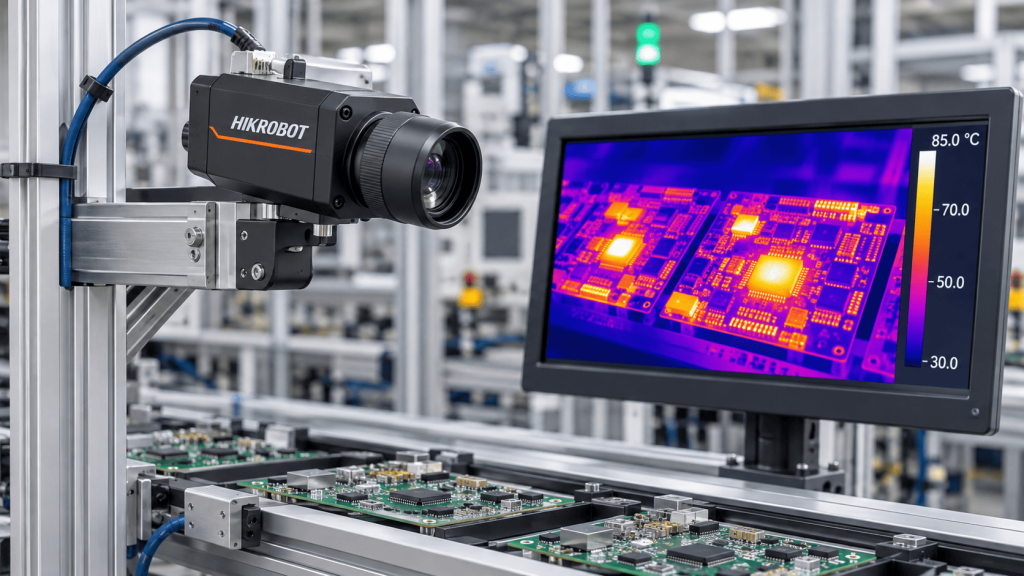
Hikrobot positions its LWIR cameras for the industrial and semiconductor sectors, including electronic semiconductors, auto parts and new energy. Thermal imaging fits electronics manufacturing and automotive production, where components generate or are exposed to heat.
Building, Safety and Security Applications
Outside the factory, LWIR is used for building diagnostics and energy audits, firefighting and seeing through smoke, gas leak detection, and surveillance of people and vehicles in darkness.
What Are the Limitations of LWIR Imaging?
LWIR cameras measure surface radiation, so they cannot see through most materials or read every surface equally well. Knowing these limits prevents wrong expectations during a project.
- No imaging through glass. Glass is opaque in LWIR, so a thermal camera cannot look through a window or a glass guard.
- Surface temperature only. As The Snell Group explains, the camera sees radiation from surfaces, not through them – and not through walls.
- Emissivity and reflections. Low-emissivity, shiny surfaces such as bare metal emit poorly and can reflect heat from their surroundings, distorting readings.
- Lower resolution. LWIR offers the coarsest spatial resolution of the three infrared bands, so very fine details are better inspected with a visible or SWIR camera.
How Do You Choose an Industrial Thermal Camera for Machine Vision?
Start with the thermal question you need to answer, then match the detector, optics and integration to it.
- Define the task. Decide whether you need to see relative heat patterns or measure actual temperatures – the second requires a radiometric camera.
- Check the surface. Shiny or low-emissivity materials may need a different approach or careful setup.
- Choose the detector type. An uncooled LWIR camera suits most monitoring and inspection; cooled detectors are for very fast events and precision measurement.
- Match the frame rate. 30–60 Hz typically covers standard monitoring.
- Plan the optics. Use germanium or other infrared lenses with a field of view that suits the working distance. General principles of machine vision lens and lighting selection still apply, apart from the lighting itself – LWIR needs none.
- Check integration. A GigE Vision interface and GenICam support let the thermal camera work with standard machine vision software.
Which LWIR Cameras Are Available for Industrial Machine Vision?
Industrial LWIR cameras are available as GigE Vision models designed to work alongside standard machine vision cameras. In the Hikrobot range, the CI long-wave infrared camera series uses a high-sensitivity uncooled vanadium oxide detector with an 8–14 µm response band.
The cameras display temperature information about the target object, comply with the GigE Vision standard, support the GenICam protocol and can transmit data up to 100 m without a repeater. They sit within the wider Hikrobot area scan camera portfolio, which also includes SWIR models such as the MV-CI050-Y1S-NN.
As an official Hikrobot distributor, ELVOTEC helps manufacturers across Hungary and Central and Eastern Europe decide whether thermal imaging fits their inspection task – contact our team to discuss your application.
Frequently Asked Questions
What is an LWIR camera used for?
An LWIR camera is used to see and measure heat: industrial process monitoring, predictive maintenance, electrical inspection, building diagnostics, firefighting and surveillance in darkness.
What wavelength does an LWIR camera detect?
LWIR cameras generally detect 8–14 µm. Some detectors are specified from 7.5 µm.
Does an LWIR camera need a light source?
No. An LWIR camera detects heat emitted by objects themselves, so it works in total darkness without illumination.
Can an LWIR thermal camera see through glass?
No. Glass is opaque to long-wave infrared, which is also why LWIR lenses are made from germanium or other infrared-transparent materials instead of glass.
What is the difference between a cooled and an uncooled LWIR camera?
An uncooled camera uses a microbolometer that works at room temperature, making it compact and lower in cost. A cooled camera uses cryogenic cooling for higher sensitivity and frame rates, mainly for fast events and precision research.