
News
The Differences Between SWIR, MWIR, and LWIR Cameras
Short-wave, mid-wave and long-wave infrared cameras all "see" light that is invisible to the human eye, but they do not see the same thing. The single most important difference is this: a SWIR camera images infrared light reflected from a surface, much like a black-and-white photo, while MWIR and LWIR cameras image heat emitted by the object itself. That one physical fact decides what each band can inspect, which sensor and optics it needs, whether it must be cooled and how much the system will cost.
This guide compares SWIR vs LWIR vs MWIR side by side – wavelength, sensor technology, image quality, cooling, optics, price and typical industrial applications – and ends with a practical checklist for choosing the right infrared band for an inspection or automation project. If you are new to camera-based inspection, start with our practical guide to machine vision.
SWIR vs MWIR vs LWIR at a glance
| Parameter | SWIR (short-wave infrared) | MWIR (mid-wave infrared) | LWIR (long-wave infrared) |
|---|---|---|---|
| Typical wavelength | 0.9–1.7 µm (extended SWIR up to ~2.5 µm) | 3–5 µm | 8–14 µm |
| What the camera sees | Reflected light (needs illumination) | Emitted heat | Emitted heat |
| Image character | Photo-like, sharp, with shadows and texture | Thermal image, good detail and contrast | Thermal image, softer edges |
| Common sensor | InGaAs focal plane array | InSb, HgCdTe (MCT), T2SL – usually cryo-cooled | Uncooled microbolometer (VOx or a-Si) |
| Cooling | None or thermoelectric (TEC) | Cryogenic (Stirling cooler) in most cameras | Not required in most cameras |
| Lens material | Glass (SWIR-corrected) | Silicon, germanium | Germanium, chalcogenide glass |
| Sees through window glass | Yes | No | No |
| Measures temperature | Only very hot objects (roughly above 250–300 °C) | Yes, high sensitivity | Yes, ambient to moderate temperatures |
| Relative cost | Medium to high | Highest | Lowest entry point into IR |
| Typical industrial use | Moisture, material sorting, silicon and fill-level inspection | Hot processes, gas leak imaging, long-range surveillance | Predictive maintenance, heat-seal and process monitoring, fire detection |
Where SWIR, MWIR and LWIR sit in the infrared spectrum
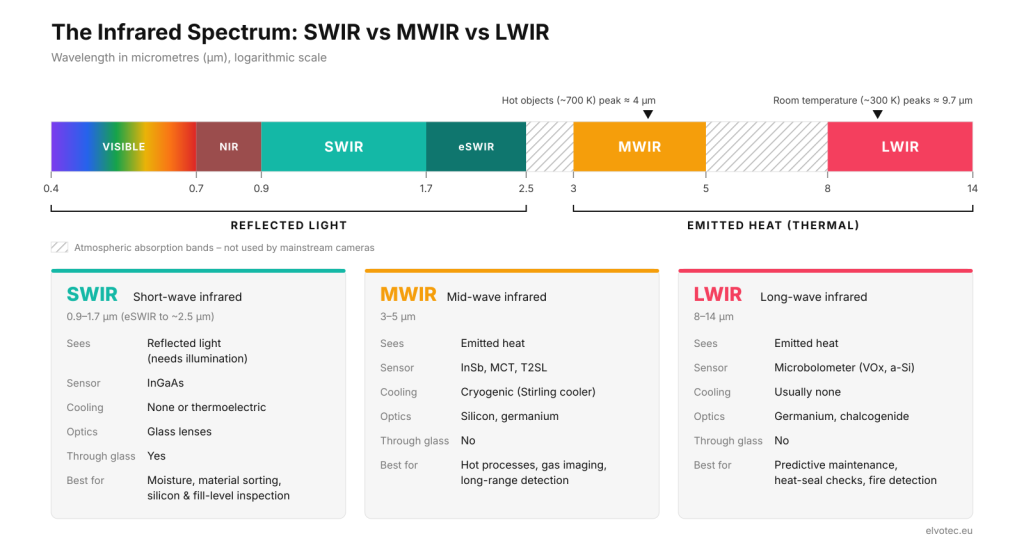
Visible light ends at about 0.7 µm. Beyond that lies the infrared spectrum, which camera makers split into bands according to how the atmosphere transmits light and which detector materials respond to it:
SWIR wavelength: the short-wave infrared band is usually defined as 0.9–1.7 µm, the range covered by standard InGaAs sensors. Extended-range (eSWIR) cameras reach about 2.2–2.5 µm, and VSWIR cameras start in the visible at 0.4 µm. Below SWIR sits the near-infrared (NIR, 0.7–1 µm) that ordinary silicon sensors can still partly detect.
MWIR wavelength: 3–5 µm, one of two "atmospheric windows" where infrared radiation travels through air with little absorption.
LWIR wavelength: 8–14 µm, the second atmospheric window and the band where most commercial thermal imaging cameras operate.
The gaps between bands (around 2.5–3 µm and 5–8 µm) are not used by mainstream cameras because water vapour and carbon dioxide absorb strongly there.
Why do heat-sensing cameras work in MWIR and LWIR rather than SWIR? Wien's displacement law gives the answer. An object at room temperature (about 300 K) emits most strongly near 10 µm, right in the middle of the LWIR window. A hot object at around 700 K peaks near 4 µm, in MWIR. Only very hot targets – molten metal, glowing glass, a laser weld pool – emit enough short-wave radiation for a SWIR camera to measure their temperature.
Reflected light vs emitted heat: the core difference
If you remember only one thing from this comparison, make it this distinction.
A short-wave infrared camera behaves like a visible camera that sees "further red". It needs a light source – sunlight, night-sky glow, halogen lamps, SWIR LEDs or an eye-safe 1550 nm laser – and it records how strongly each surface reflects or absorbs that light. The result looks like a monochrome photograph: shadows, edges, printed text and surface texture are all visible. Because many materials reflect SWIR differently from visible light, the camera can separate things that look identical to the eye.
A long-wave infrared camera (and an MWIR camera) needs no illumination at all. Every object above absolute zero emits infrared radiation, and the camera turns that radiation into an image or a temperature map. It works in total darkness, but it shows heat patterns rather than surface detail. Two parts at the same temperature can look almost identical even if one is a different colour or material.
Put simply: SWIR answers "what is this made of and what does it look like?", while LWIR and MWIR answer "how hot is it?"
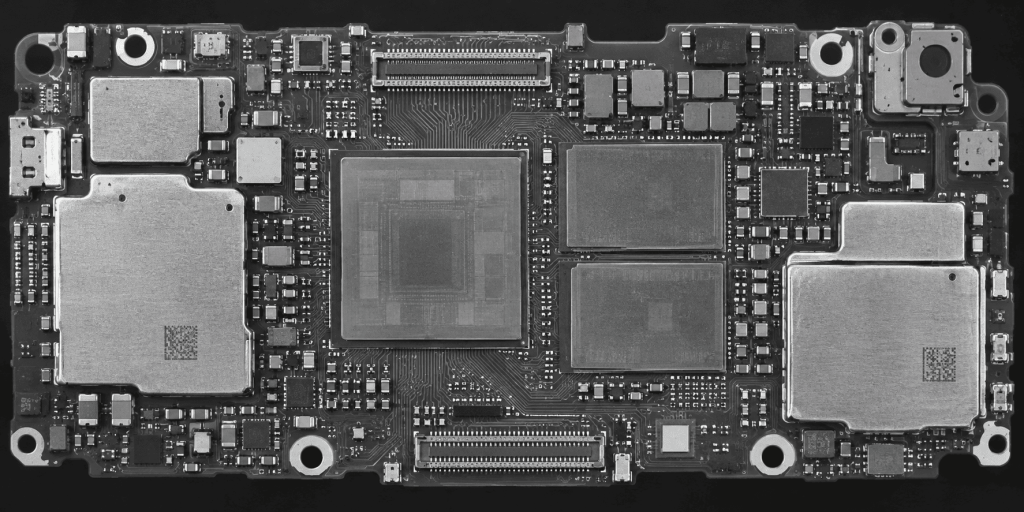
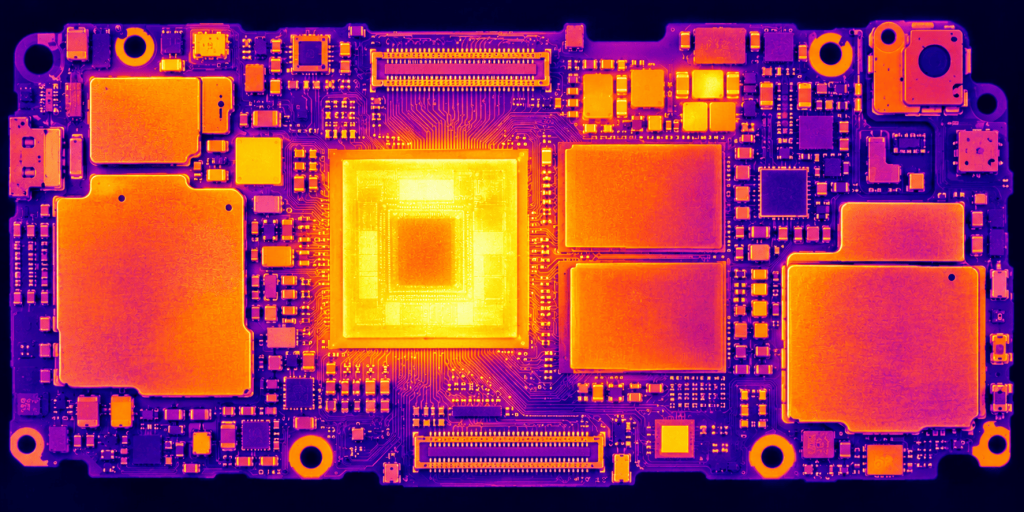
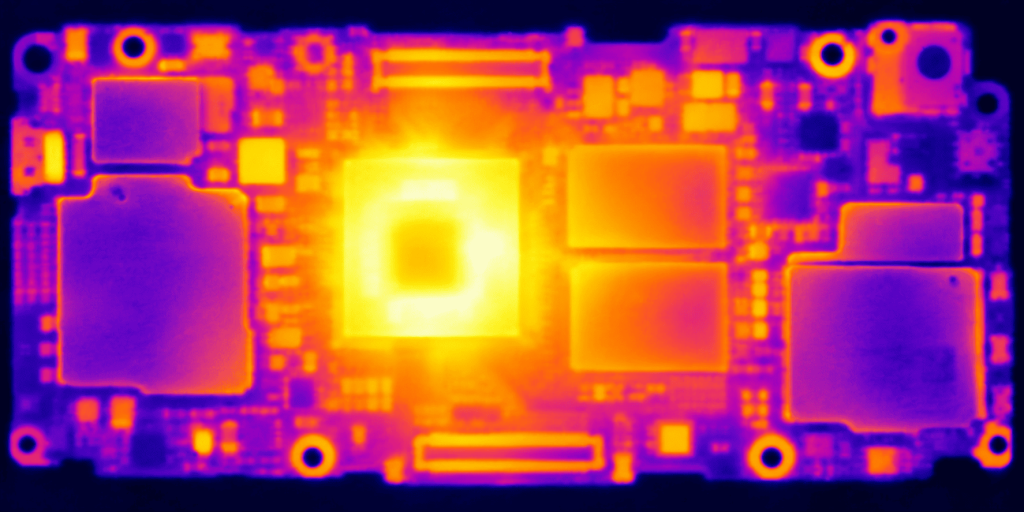
The illustrations below show how the same smartphone circuit board would look through each type of camera.
SWIR cameras: short-wave infrared imaging explained
SWIR sensor technology
Standard silicon CMOS sensors lose sensitivity above about 1 µm, so a SWIR sensor uses a different material – almost always indium gallium arsenide (InGaAs) bonded to a silicon readout circuit. Classic InGaAs cameras had relatively large pixels (15–25 µm) and modest resolution. Sony's SenSWIR sensors changed the market by bringing 5 µm pixels and resolutions above 1 megapixel, covering both visible and SWIR light on one chip. For wavelengths beyond 1.7 µm, extended InGaAs or MCT detectors are used, usually with stronger cooling.
Most SWIR cameras run uncooled or with a small thermoelectric (TEC) cooler to keep dark noise low during long exposures. They use ordinary glass lenses (ideally with SWIR anti-reflection coatings) and standard machine vision interfaces such as GigE Vision, USB3 Vision or Camera Link. SWIR line scan cameras are also available for continuous web and conveyor inspection – see how area scan and line scan cameras differ.
What SWIR imaging reveals
SWIR imaging is valuable precisely where visible cameras fail:
Moisture and water content. Water absorbs strongly around 1450 nm, so wet areas appear dark in a SWIR image. This is used to check drying of wood, paper, textiles and grain, and to detect bruises under fruit skin.
Material identification and sorting. Plastics, foods and minerals have characteristic SWIR absorption features. Recycling lines and food sorters use SWIR (often hyperspectral) cameras to separate materials that look the same in visible light – a frequent need in food and beverage automation.
Looking through materials. Silicon is transparent above about 1.1 µm, so a SWIR camera can inspect solar cells and wafers for cracks, voids and bonding defects – an established technique in electronics manufacturing. Many thin plastics and paper labels also become partly transparent, which allows fill-level checks through opaque bottles.
Haze and glass. SWIR light scatters less than visible light in haze and smoke, and unlike thermal bands it passes straight through window glass, so a camera can sit behind a protective window.
Laser lines and covert illumination. 1064 nm and 1550 nm lasers, invisible to people, show up clearly in SWIR – useful for laser alignment, triangulation and eye-safe active illumination.
Limitations of SWIR
A SWIR camera is not a thermal camera. It cannot see warm people or machines in darkness without illumination, and it measures temperature only for very hot targets. InGaAs sensors are also more expensive than silicon, and per pixel they usually cost more than uncooled LWIR microbolometers, although the price gap has narrowed.
MWIR cameras: the mid-wave band for hot targets and long range
Mid-wave infrared cameras detect emitted heat in the 3–5 µm window. Most use photon detectors – indium antimonide (InSb), mercury cadmium telluride (HgCdTe, also called MCT) or type-II superlattice (T2SL) – that must be cooled to cryogenic temperatures by an integrated Stirling cooler. Newer "HOT" (high operating temperature) MWIR detectors reduce cooler size and power but do not remove it.
The payoff for that complexity is performance. Cooled MWIR cameras offer very high thermal sensitivity (low NETD), short integration times for fast-moving or hot objects, and good image detail because the wavelength is shorter than LWIR. They are the band of choice for:
High-temperature processes such as glass forming, metal heat treatment and furnaces, where special filters let the camera see through flames.
Optical gas imaging (OGI) of methane and other hydrocarbons, which absorb strongly in the mid-wave band.
Long-range surveillance, especially in humid or maritime air where MWIR typically outranges LWIR.
The downsides are price, size and maintenance: cryocoolers need minutes to cool down and periodic servicing, which is why MWIR is rarely the first choice for routine factory inspection.
LWIR cameras: long-wave infrared thermal imaging
Uncooled microbolometers
A long-wave infrared camera senses the 8–14 µm band, where objects at everyday temperatures emit most strongly. The vast majority of LWIR cameras use uncooled microbolometers – tiny vanadium oxide (VOx) or amorphous silicon (a-Si) elements that change electrical resistance as they absorb heat. Because no cryocooler is needed, an LWIR thermal camera can be compact, low-power, maintenance-free and comparatively affordable. Typical uncooled cameras resolve temperature differences well below 0.1 °C. Cooled LWIR cameras exist too, but they are reserved for research and demanding defence work.
The physics of longer wavelengths has a cost: diffraction limits the smallest resolvable detail, pixels are larger (typically 10–17 µm) and resolution is lower than SWIR or visible cameras. Optics must be made of germanium or chalcogenide glass, because ordinary glass is opaque at these wavelengths – an LWIR camera aimed at a window sees only the window's own temperature and reflections.
Where LWIR cameras fit in industry
Predictive maintenance: overheating motors, bearings, electrical cabinets and connectors show up long before they fail.
Process and quality monitoring: heat-seal integrity on packaging, adhesive and glue bead application, plastic welding and curing temperatures – a natural extension of machine vision quality control.
Fire and safety: early detection of hot spots in waste bunkers, warehouses and battery storage.
People and vehicle detection in darkness, smoke and dust, where LWIR penetrates particulates better than shorter wavelengths.
SWIR vs LWIR: which band fits your inspection task?
The SWIR vs LWIR decision usually comes down to whether the defect you need to find shows up as a reflectance difference or a temperature difference. The table below maps common industrial tasks to the band that typically handles them best.
| Inspection task | Better band | Why |
|---|---|---|
| Moisture in wood, paper, grain, textiles | SWIR | Water absorption around 1450 nm creates strong contrast |
| Sorting plastics, food or minerals | SWIR | Materials differ in SWIR reflectance even when colour is the same |
| Cracks inside silicon wafers and solar cells | SWIR | Silicon is transparent above ~1.1 µm |
| Fill level through opaque plastic containers | SWIR | Many plastics transmit SWIR light |
| Reading laser lines or marks at 1064/1550 nm | SWIR | Laser light is invisible to visible cameras |
| Imaging through a protective glass window | SWIR | Glass is opaque to MWIR and LWIR |
| Overheating motors, bearings, electrical panels | LWIR | Ambient-temperature faults emit in 8–14 µm |
| Heat-seal and glue-bead verification | LWIR | Defects appear as temperature differences |
| Detecting people, vehicles or fire in darkness and smoke | LWIR | No illumination needed; good penetration of smoke and dust |
| Temperature of molten metal or glass above ~300 °C | SWIR or MWIR | Short wavelengths reduce emissivity errors on hot metals |
In some projects, the honest answer is "both": a SWIR camera checks surface or material quality, while an LWIR camera verifies a thermal step on the same line. Combining them is a normal machine vision integration task.
MWIR vs LWIR: choosing between the two thermal bands
When the job is clearly thermal, the question becomes MWIR or LWIR. As a rule of thumb:
Choose LWIR for objects near ambient temperature, for continuous 24/7 monitoring on a budget, for compact installations and for environments with smoke or dust. Uncooled LWIR is the default for industrial thermography.
Choose MWIR for hot targets, very fast events, gas imaging, high thermal sensitivity at long distance and measurements through flames or hot gases – and when the budget allows a cooled camera.
Optics, cooling and cost: the hidden differences
Optics. SWIR lenses are made of glass and cost little more than good machine vision lenses. MWIR and LWIR lenses use germanium, silicon or chalcogenide materials, which makes infrared optics a significant share of a thermal system's price – especially for long focal lengths.
Cooling. SWIR: none or thermoelectric. LWIR: none for microbolometers. MWIR: cryogenic cooling in most cameras, adding cost, power draw, start-up time and service intervals.
Price. Uncooled LWIR is generally the cheapest way into infrared imaging. InGaAs SWIR cameras usually sit in the middle, and cooled MWIR cameras are the most expensive. Exact prices depend heavily on resolution, frame rate and whether the camera is radiometric (calibrated for temperature measurement).
Export rules. Many infrared cameras, especially cooled and high-frame-rate thermal models, are treated as dual-use goods under export control regulations. This can affect delivery times and paperwork, so it is worth checking early in a project.
How to choose the right infrared camera: five questions
1. Is the defect a material/surface difference or a temperature difference? Material or surface points to SWIR; temperature points to LWIR or MWIR.
2. How hot is the target? Near ambient: LWIR. Hundreds of degrees: MWIR or SWIR thermography.
3. Can you illuminate the scene? SWIR needs a light source; thermal cameras do not.
4. What is between the camera and the target? A glass window rules out MWIR/LWIR; smoke and dust favour LWIR.
5. How much detail do you need? For fine features, SWIR resolution is far higher than LWIR at the same lens size.
Integrating infrared cameras into a machine vision system
Choosing the band is only half the work. An infrared camera still needs the right lens, lighting (for SWIR), triggering, software and a mechanical and electrical integration that survives the production environment. Many SWIR and thermal cameras support GigE Vision and GenICam, so they can work alongside standard smart cameras and industrial cameras in one inspection cell.
ELVOTEC designs and integrates machine vision systems for manufacturers in Hungary and across Central and Eastern Europe. If you are unsure whether your application needs SWIR, LWIR or a combination of visible and infrared imaging, our engineers can review samples and recommend a setup.
Frequently asked questions
What is the main difference between SWIR and LWIR cameras?
A SWIR camera images short-wave infrared light (about 0.9–1.7 µm) reflected from objects, producing sharp, photo-like images that need illumination. An LWIR camera images long-wave infrared radiation (8–14 µm) emitted by objects as heat, so it works in total darkness and can measure temperature, but with lower resolution.
Is a SWIR camera a thermal camera?
Generally no. SWIR cameras detect reflected light, not heat. Only very hot objects, roughly above 250–300 °C, emit enough short-wave radiation for a SWIR camera to measure temperature. For ambient-temperature thermal imaging, an LWIR or MWIR camera is needed.
Can SWIR or LWIR cameras see through glass?
SWIR cameras can see through ordinary window glass and use standard glass lenses. LWIR and MWIR cameras cannot: glass is opaque at thermal wavelengths, so they need germanium or similar lenses and will only see the glass surface and its reflections.
What is the difference between MWIR and LWIR?
Both are thermal bands. MWIR (3–5 µm) cameras are usually cryo-cooled, very sensitive and best for hot targets, gas imaging and long range. LWIR (8–14 µm) cameras usually use uncooled microbolometers, are cheaper and more compact, and are the standard choice for objects near room temperature.
Which infrared camera is the cheapest: SWIR, MWIR or LWIR?
Uncooled LWIR cameras are generally the lowest-cost entry point into infrared imaging. InGaAs SWIR cameras usually cost more, and cooled MWIR cameras are the most expensive because of their detectors, cryocoolers and infrared optics.
Do SWIR cameras need cooling?
Most SWIR cameras work uncooled or with a small thermoelectric cooler that reduces dark noise for long exposures. Deep cryogenic cooling is only used in specialised extended-range or scientific SWIR cameras.
Which band is better for detecting moisture?
SWIR. Water absorbs strongly around 1450 nm, so wet areas appear dark in a SWIR image. This makes short-wave infrared imaging a common choice for checking moisture in wood, paper, textiles, grain and food.